The gym teacher—a big bear of a man—surveys his fourth and fifth graders at recess, inert and buried in smart phones and laptops on their battered schoolyard. He challenges them to enter a jungle of imagination, to take on the roles of animals and the young human foundling raised by wolves, who faces life and death decisions, and the future.
So begins the HSU production of Edward Mast’s prize-winning play Jungalbook, a family drama with comedy and magic based on tales from Rudyard Kipling’s famous The Jungle Book.
Jungalbook is performed by HSU students in the Van Duzer Theatre on Friday and Saturday, February 26 and 27 at 7:30 p.m., and Thursday through Saturday evenings, March 3-5, with a 2 p.m. matinee on Sunday March 6. Tickets are $10 general/$8 students and seniors, with a limited number of free tickets for HSU students at each performance, from the HSU Ticket Office (826-3928) or at the door. Produced by HSU Department of Theatre, Film & Dance.
Media: Eureka Times Standard Urge Magazine, Mad River Union, Humboldt State Now
Archive of pre-production information and photos 2007-2016, Humboldt State University Theatre, Film and Dance Performances in Arcata, California.
Showing posts with label Edward Mast. Show all posts
Monday, February 29, 2016
Friday, February 12, 2016
Packed with action, comedy and magic, unfolding in short, fast-paced scenes, the Jungalbook story centers on the coming of age of Mowgli (played by Camille Borrowdale), a human baby left in the jungle but saved by the panther Bagheera (Bryan Kashon), who bargained with Akela, the leader of the wolf pack (Hanah Toyoda), to protect and raise the infant.
![]() |
| Matthew Hern, Camille Borrowdale, Jenna Donahue. All actors are HSU students. |
Jungalbook: Our Cast and Production
Baloo: Matthew Hern
Bagheera: Bryan Kashon
Sherakhan: Jenna Donahue
Mowgli: Camille Borrowdale
Akela: Hanah Toyoda
Grab: Roman Sanchez
Hathi: Elio Robles
Grey: Ivan Gamboa
Kaa: Rilo DeAnn
Perchy: Ashlyn Mather
Chill: Josh Banuelos
Hyena/Baby Buffao: Isabella Ceja
Production
Director: Troy M. Lescher
Scenic Designer: Derek Lane
Lighting Designer: James McHugh
Assistant Lighting Designer: Makenna Baker
Costume/Hair Designer: Alexander Stearns
Sound Designers: Derek Lane, Cory Stewart
Props/Puppet/Mask Designer: Sydnee Stanton
Production Manager: Derek Lane
Assistant Director: Heidi Voelker
Assistant Director: Heather Karns
Stage Manager: Jillian Park
Assistant Stage Managers: Sarina Rodriguez, Sammi Stowe
Light Board Operator: Kai Lassen
Sound Board Operator: Cate Hatfield
Head Dresser: Sarah Haley Burfoot
Hair/MakeUp Crew: Connie Hill
Costume Shop Manager:Catherine Brown
Sound/Projections/Lighting Manager:Pablo Midence
Prop Shop Manager: Emma Lubin
Scene Shop Manager: Jayson Mohatt
Administrative Support: Debra Ryerson, Lorraine Dillon
Photography: Kellie J. Brown
Publicity/site copy & design: Bill Kowinski
Jungalbook: The Director
![]() |
| Director Troy Lescher |
“There’s a lot of action,” he said. “In our staging, scenes are short and fast. There are a lot of light moments in the play, moments of joy and humor and pleasure, but also some heavy and dark moments. The jungle is a place of adventure but also of danger. That’s one reason this story appeals to young and old.”
New audiences can be captivated by the characters coming to grips with themes of loyalty, identity, friendship and coping with fear. But older audiences can share in the discovery. “We sort of know what The Jungle Book stories are,” Lescher said, “and we sort of don’t.”
“It’s also a play that has fantasy and magic in a realistic setting,” he said, “so it’s a challenge to create that with lighting and sound and transforming the space.”
Using the startling premise of Edward Mast’s script (and all of his words), the play is set in a contemporary playground. But Lescher also devised a framing story that provides a rationale for skeptical adults, and especially skeptical kids.
“Our story begins with a group of fourth and fifth graders, all in drab school uniforms, during recess in an urban schoolyard. The recess monitor, a PE teacher, notices that they are so absorbed in technology that they aren’t engaging with one another, and they aren’t using their imaginations."
" So he gets the idea of sending a jolt of electricity into the playground by involving them in an activity called The Jungalbook. The students discover pieces of clothing in the ‘lost and found’ container, and use them to inhabit various animals in the story. And that’s how human characters transform into the animal characters.”
“For most of the parts, gender isn’t specified,” Lescher said. “Once I cast the antagonist—the tiger Sheracon—with a female actor (Jenna Donahue), I thought it made sense to cast a woman as the protagonist as well. From a storytelling perspective, that works better.”
“Also, one of the major themes of the story is bullying, and although we sometimes think that young men do all the bullying, research has shown that young women do as much, but in different ways.”
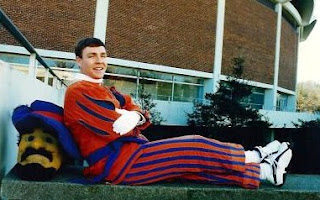
As a theatre actor, Troy Lescher was following a fairly conventional path. From elementary school and high school in his hometown of Bloomington, Illinois, he performed in the usual plays and musicals. He continued on that path in college at the University of Virginia. But then he won a job as the performing mascot—the Virginia Cavalier—and everything began to change.
“I was one of three young men who performed at football and basketball games, wearing that costume and a huge mask on my head.” Some of the actor’s primary tools—words, voice and facial expressions--were gone. “I began to embrace physical acting work, where it’s more about the body as a communication tool in storytelling. That got me into clowning.”
After college he moved to New York City, interned with a clown troupe and became a street performer. He clowned at corporate gigs, took a one-person puppet show to public schools and libraries, all while acting in off-off Broadway shows and pursuing a Masters in Fine Arts at Brooklyn College.
He started teaching during his nine years in New York, and completed his doctorate in Texas with a dissertation on clown training. “I was still drawn to movement work,” he said. “It’s amazing what our bodies can tell an audience.”
![]() |
| Cavalier Troy |
While his wife began teaching English at CR, Troy started his latest gig--as an assistant professor in the HSU Theatre, Film & Dance department—and almost immediately, as the director of Jungalbook.
That process began with concept meetings with designers in September, and auditions in November. Then the havoc of an academic schedule came into play. “There are lots of breaks in this period—Thanksgiving, Christmas, semester break and a week when everybody goes to the Kennedy Center American College Theatre Festival. Plus finals. So what’s normally a six or seven week rehearsal period is spread out over six months.”
But that did provide opportunities for actors to go deeper into the story and their characters, on their own. After early weeks analyzing the text and building an ensemble, Lescher gave them some homework, relevant to the physical acting they were learning.
Most would be portraying animals--not only the bear, tiger, wolves and panther that drive the main story, but also elephant, python, monkey, hyena, vulture and buffalo. “I asked each of them to screen four or five Youtube or National Geographic videos of the animal they were going to play, to zero in on postures, style of movement, respiratory patterns, the sounds of their animals, so we could incorporate this into their acting work.”
He also asked them to read the appropriate pages of Animal Speak, a popular book by Ted Andrews about animal totems. “The book talks about individual animals, what they represent, the energies they give off and their connection to the world. I asked them to read the sections that apply to their animal, to give them an idea of that animal’s significance, what makes it unique. I wanted them to develop respect, and fall in love with their characters.”
Inhabiting their characters physically provided student actors with insights beyond this play. “Teachers talk about ‘the light bulb moment’ when students suddenly understand an important idea. I love to see when actors do something with their bodies or voices or even their emotions, when they make an acting choice that surprises them—and they realize ‘That was in me, and I just found it.’”
Lescher is eager to experience how they apply these insights to performing Jungalbook. “I want to empower them as storytellers. And that’s what I tell them—it’s your story, you’re the ones who will go on stage and share this tale with the audience. I hope they will enjoy and embrace every moment they have on stage. The run is over in just a couple of weeks, and I hope they own and embrace every moment along the way.”
“So I’m excited to pass the torch to the students come opening night, and see them run with this thing--and blow the doors off. Because that’s what we should be doing.”
Jungalbook:The Playwright and the Play
Rudyard Kipling’s tales collected in several volumes of The Jungle Book have been adapted in many media, including music, comics, stage, television and the movies--the best known probably being the 1967 Disney animated film. Disney is set to release a new star-studded live action version of The Jungle Book this April.
But the most widely performed stage adaptation is this one: Jungalbook by Edward Mast.
The Jungle Book was first published in 1894. Edward Mast wrote his adaptation in 1984.
Born in California, Mast earned his B.A. and M.F.A. in playwriting at Sonoma State University, a sister university to HSU in the CSU system. Mast became a fan of The Jungle Book in his twenties.
“When I came to imagine an audience for a dramatization, naturally I thought of children,” he wrote in the introduction to the published play. “This was partially because the stories spoke to my own childhood world of loyalty, adventure and betrayal, but also because I feared that an audience of grown-ups would require a snicker or a sidelong glance from actors pretending to be bears and hyenas. At the same time, I feared that children might find the themes of the play too merciless or harsh.”
“I was wrong on both counts. Adults were challenged by the grimness of the play much more than children, though many seemed to respond to the same qualities of the story that I did. The young people, on the other hand, taught me that the younger the audience, the more it is filled with passionate extremists, hungry for actions of inevitability and consequence, eager to witness the workings and misworkings of justice, emotion and responsibility. Why any of this should have surprised me, I don’t know; as a child, I was much more enthusiastic about grappling with grown-up issues than I am as a comparative grown-up.”
Jungalbook won the 1991 Distinguished Play Award from the American Alliance for Theatre and Education.
The main character in Jungalbook is Mowgli, the human foundling raised by wolves. Eight of the stories in the two volumes of The Jungle Book (three in Book One, five in Book Two) involve Mowgli as a character. Mast uses elements of several of these, especially the first (“Mowgli’s Brothers.”) There are also differences from what happens in Kipling’s tales.
Mast moved the action from the jungles of India to a “jungle gym” on an urban playground. Since its first production, Jungalbook has been staged many times, by professional and community theatres, and by colleges, high schools and elementary schools. Various productions have modified the setting, such as emphasizing gang warfare in an urban jungle (as in productions at Northwestern and Sarah Lawrence.)
Other productions are staged more specifically in schoolyards, as is this HSU production.
Though Mast calls for ordinary playground clothes, some productions use elaborate costumes and makeup. The HSU production takes an organic approach, as the school kids select costume elements from a “lost and found” box and put them to imaginative use in suggesting their animal characters.
Some productions even improvise dialogue. At HSU, there is a framing narrative (the coach/recess monitor challenging students to imagine the jungle story) but once that narrative begins, the actors stick to the script and say the lines as Mast wrote them.
Based in Seattle, Edward Mast has continued to perform and to write plays. His adaptation of H.G. Wells’ The Time Machine was staged by Ohlone College, and produced on the Van Duzer Theatre stage as part of the 2011 Kennedy Center American College Theatre Festival hosted that year by HSU.
Mast’s work with a group of Seattle activists called Theater Squad was the subject of a 2012 article by Theresa J. May, theatre professor at the University of Oregon, former member of the HSU Theatre, Film and Dance Department, and co-author of HSU’s current Book of the Year, Salmon Is Everything.
But the most widely performed stage adaptation is this one: Jungalbook by Edward Mast.
The Jungle Book was first published in 1894. Edward Mast wrote his adaptation in 1984.
Born in California, Mast earned his B.A. and M.F.A. in playwriting at Sonoma State University, a sister university to HSU in the CSU system. Mast became a fan of The Jungle Book in his twenties.
“When I came to imagine an audience for a dramatization, naturally I thought of children,” he wrote in the introduction to the published play. “This was partially because the stories spoke to my own childhood world of loyalty, adventure and betrayal, but also because I feared that an audience of grown-ups would require a snicker or a sidelong glance from actors pretending to be bears and hyenas. At the same time, I feared that children might find the themes of the play too merciless or harsh.”
“I was wrong on both counts. Adults were challenged by the grimness of the play much more than children, though many seemed to respond to the same qualities of the story that I did. The young people, on the other hand, taught me that the younger the audience, the more it is filled with passionate extremists, hungry for actions of inevitability and consequence, eager to witness the workings and misworkings of justice, emotion and responsibility. Why any of this should have surprised me, I don’t know; as a child, I was much more enthusiastic about grappling with grown-up issues than I am as a comparative grown-up.”
Jungalbook won the 1991 Distinguished Play Award from the American Alliance for Theatre and Education.
The main character in Jungalbook is Mowgli, the human foundling raised by wolves. Eight of the stories in the two volumes of The Jungle Book (three in Book One, five in Book Two) involve Mowgli as a character. Mast uses elements of several of these, especially the first (“Mowgli’s Brothers.”) There are also differences from what happens in Kipling’s tales.
Mast moved the action from the jungles of India to a “jungle gym” on an urban playground. Since its first production, Jungalbook has been staged many times, by professional and community theatres, and by colleges, high schools and elementary schools. Various productions have modified the setting, such as emphasizing gang warfare in an urban jungle (as in productions at Northwestern and Sarah Lawrence.)
Other productions are staged more specifically in schoolyards, as is this HSU production.
Though Mast calls for ordinary playground clothes, some productions use elaborate costumes and makeup. The HSU production takes an organic approach, as the school kids select costume elements from a “lost and found” box and put them to imaginative use in suggesting their animal characters.
Some productions even improvise dialogue. At HSU, there is a framing narrative (the coach/recess monitor challenging students to imagine the jungle story) but once that narrative begins, the actors stick to the script and say the lines as Mast wrote them.
Based in Seattle, Edward Mast has continued to perform and to write plays. His adaptation of H.G. Wells’ The Time Machine was staged by Ohlone College, and produced on the Van Duzer Theatre stage as part of the 2011 Kennedy Center American College Theatre Festival hosted that year by HSU.
Mast’s work with a group of Seattle activists called Theater Squad was the subject of a 2012 article by Theresa J. May, theatre professor at the University of Oregon, former member of the HSU Theatre, Film and Dance Department, and co-author of HSU’s current Book of the Year, Salmon Is Everything.
Jungalbook: Rudyard Kipling in America
The first writer in English to receive the Nobel Prize in Literature, Rudyard Kipling was one of the most popular and internationally famous British authors of the late nineteenth and early twentieth centuries. But he wrote the tales collected in The Jungle Book while living as a young married man in the United States.
Kipling was born in India of English parents, and spent the first five years of his childhood there. He was then sent to relatives in England for his education, where he experienced “a certain amount of bullying,” as he later wrote.
In an historical oddity, Kipling spent this part of his childhood in the nondescript town of Southsea, where in just a few years the teenage H.G. Wells and the young doctor Arthur Conan Doyle would briefly live. All three would become major writers whose work lives on in contemporary culture.
At 16, Kipling returned to India to work for a newspaper. He spent seven years or so in that vast country as a writer and editor. Some of his newspaper stories were collected in a book, and with the money it earned he decided to return to London.
But he did so by way of North America. Kipling sailed to San Francisco and eventually took a train to Portland, Oregon on a route apparently a bit inland from the North Coast. He later traveled to Seattle and British Columbia, then through the Midwestern US to Pennsylvania and New York (where he met and befriended Mark Twain) before crossing the Atlantic to England.
But he must have liked what he saw, because after a few years as a budding author in England, he got married and selected the United States for his honeymoon. And it turned out to be a long one—about four years. He and his wife remained in Vermont, and had two daughters there. (By this time he was friends with Conan Doyle, who visited him in Vermont and taught him to play golf. Though he hadn’t met H.G. Wells, they had the same London editor.)
During those Vermont years, Kipling wrote some of his most famous works, including the poem “Gunga Din,” the novel Captains Courageous, and the tales set in the jungles of India, collected in two volumes of The Jungle Book.
He wrote these tales for young readers, and enjoyed letters from children responding to their publication in periodicals. In 2010, a note in his hand found on a first edition indicates that Kipling wrote the tales expressly for his first daughter, Josephine, who died at the age of 6.
His work following his U.S. stay in particular became controversial, and marked him as an apologist for imperialism and militarism. But at least in his early work, he was an intuitive writer. His motto for writing was “drift, wait and obey.”
Kipling is not much known in the United States today, except through The Jungle Book. Its influence also lives on in the Cub Scouts. Robert-Baden Powell, founder of the Scouts, deliberately adopted elements from Kipling’s jungle tales (with the author’s permission.) That the Cub Scouts are organized in “dens”, and the dens in “packs” as well as other elements, are all directly from The Jungle Book. Even the name of the den leader—Akela—is the name of the wolf leader in The Jungle Book-- and Jungalbook.
Kipling was born in India of English parents, and spent the first five years of his childhood there. He was then sent to relatives in England for his education, where he experienced “a certain amount of bullying,” as he later wrote.
In an historical oddity, Kipling spent this part of his childhood in the nondescript town of Southsea, where in just a few years the teenage H.G. Wells and the young doctor Arthur Conan Doyle would briefly live. All three would become major writers whose work lives on in contemporary culture.
At 16, Kipling returned to India to work for a newspaper. He spent seven years or so in that vast country as a writer and editor. Some of his newspaper stories were collected in a book, and with the money it earned he decided to return to London.
But he did so by way of North America. Kipling sailed to San Francisco and eventually took a train to Portland, Oregon on a route apparently a bit inland from the North Coast. He later traveled to Seattle and British Columbia, then through the Midwestern US to Pennsylvania and New York (where he met and befriended Mark Twain) before crossing the Atlantic to England.
![]() |
| The Twain-Kipling meeting was so famous that it became the subject of this Old Crown Whiskey ad. |
But he must have liked what he saw, because after a few years as a budding author in England, he got married and selected the United States for his honeymoon. And it turned out to be a long one—about four years. He and his wife remained in Vermont, and had two daughters there. (By this time he was friends with Conan Doyle, who visited him in Vermont and taught him to play golf. Though he hadn’t met H.G. Wells, they had the same London editor.)
During those Vermont years, Kipling wrote some of his most famous works, including the poem “Gunga Din,” the novel Captains Courageous, and the tales set in the jungles of India, collected in two volumes of The Jungle Book.
![]() |
| Josephine Kipling |
His work following his U.S. stay in particular became controversial, and marked him as an apologist for imperialism and militarism. But at least in his early work, he was an intuitive writer. His motto for writing was “drift, wait and obey.”
Kipling is not much known in the United States today, except through The Jungle Book. Its influence also lives on in the Cub Scouts. Robert-Baden Powell, founder of the Scouts, deliberately adopted elements from Kipling’s jungle tales (with the author’s permission.) That the Cub Scouts are organized in “dens”, and the dens in “packs” as well as other elements, are all directly from The Jungle Book. Even the name of the den leader—Akela—is the name of the wolf leader in The Jungle Book-- and Jungalbook.
Subscribe to:
Posts (Atom)


