Monday, April 15, 2013

May 2013: PROOF


Locked in her father's desk is a notebook with the startling proof of a basic math question that alone would make its author famous. But what is its real secret? Only Catherine has the key.

Is it love or ambition? Is it genius or madness? And what’s the proof?

 Experience the Pulitzer Prize winning play Proof, Thursdays-Saturdays April 25-27 and May 2-4 at 7:30 p.m. and Sundays April 28 and May 5 at 2 p.m. at the Gist Hall Theatre on the HSU campus in Arcata, $10 general/$8 seniors and students, with a limited number of free seats to HSU students at each performance, from HSU Box Office (826-3928) or at the door.  Directed by Michael Thomas, produced by the HSU Department of Theatre, Film & Dance.

Media: Tri-City Weekly, Humboldt State Now, KHSU Art Waves, Arcata Eye, North Coast Journal
Queena DeLany as Claire, Kyle Handziak as Hal, Dakota Dieter as Catherine

Catherine is a young woman with a lot to prove—to her lover, her sister, her departed father, and especially to herself. 

 Was she a good daughter? Has she inherited her father’s math genius or his madness—or both?  Has she made math history, or is she as deluded as he was? 

 Is her sister right about her—that she needs to be taken care of?

 Why doesn’t her new boyfriend believe her? Has she followed her heart into the wrong relationship? 

What does it mean if they won't believe her or trust her--without proof?

 Proof is a mystery, a love story and a family drama with humor, emotion and intelligence.
Kyle Handziak as Hal, Dakota Dieter as Catherine 
Proof by David Auburn won both the Pulitzer Prize for Drama and the Tony for Best Play in 2001. With 917 performances, it was the longest-running non-musical on Broadway in 20 years. It has since been performed in many countries and in more than 30 languages.
James Read as Robert,  Dakota Dieter as Catherine
It’s Catherine’s 25th birthday, and also the day of her father’s funeral. He (Robert) was a math genius who slipped into mental illness. Catherine took care of him in his last years. Her sister Claire is trying to get her away from this life, while her new boyfriend Hal searches for a math breakthrough in the notebooks Robert left behind, though they mostly chronicle his delusions.

 Then Catherine reveals the notebook with the proof that mathematicians have been searching for since there was mathematics.  But who really wrote it?

 So begin the questions that grip the characters and have mesmerized audiences around the world.

Just as the characters have doubts about each other, the audience is confronted with the same questions. Is Catherine a math prodigy or delusional? Is Hal sincere or just ambitious? Is sister Claire caring or controlling?

 “It’s a play that makes you think,” said director Michael Thomas, “but that’s because you care about the characters. The playwright gets the audience involved very quickly. The language he uses is easily understood, it invites people in. ”


PROOF: Our Production

Our Cast
 Catherine: Dakota Dieter
Robert: James Read
 Hal: Kyle Handziak
Claire: Queena DeLany

 Our Production 

Director: Michael Thomas
 Producer: Margaret Kelso
 Set Designer: Lynnie Horrigan
 Lighting Designer: James McHugh
Sound Designer: Glen Nagy
 Costume/Makeup/Hair Designer: Marissa Menezes
Prop Designer: Andrew Buderi
Technical Director: Jayson Mohatt
 Stage Manager: JuanCarlos Contreras
 Assistant Director: Shea King
 Assistant Stage Manager: Adrienne Ralsten
 Assistant Lighting Designer: Katie Dawson
 Costume Shop Manager: Catherine Brown
 Costume Advisor: Rae Robison

PROOF at HSU: The Director

Michael Thomas has made theatre his career. He’s executive director of North Coast Repertory Theatre, where he most recently directed David Mamet’s American Buffalo. At HSU he’s directed M. Butterfly and Neil LaBute’s Fat Pig. But in high school, he loved mathematics.

 “I got as far as Advanced Placement calculus,” he confessed. “I loved math because it’s clean—you do the steps, a-b-c, you get an answer, and it’s either right or it’s wrong. Math is cool and it’s beautiful.”

 But college level calculus was as far as he got before he turned to what he called “this artsy stuff, where your heart and your opinions matter.”

 Still, in describing the artistic ambiguities of Proof, he stated his thesis and backed it up with a 1-2-3-4 series of arguments. Kind of like, well...a proof.

 “The story is about a young woman and her validation in pretty clear-cut areas. Area 1: As a woman, can she have a relationship? Can she be accepted by Hal, this man she’s interested in? Can she be a whole person? That’s validation.”

 “Area 2: Is she a real mathematician? She’s untrained but she seems to have incredible ability. But can she be validated as a mathematician? ‘Here is my work: validate me.’” 

“Area 3: Her relationship with her father. Has she been a good daughter? Did she do the right thing in how she took care of him? Was she right to keep him at home instead of in an institution? She needs validation.”

 “Area 4: Her relationship with her sister. Her sister Claire is afraid Catherine is going to become mentally unstable like their father. Claire’s mission is to move Catherine to New York where she can take care of her, whether Catherine wants it or not. Catherine needs her sister to believe in her: validation.”

 “These are the four areas she is exploring in the play, looking for answers, looking for validation.” But unlike math, life—and this play—rarely provides one right answer.

 “I don’t think the playwright spells out the answers entirely. He leaves things open. Instead the playwright creates these very believable characters, and in most cases, very likable characters. He gets us to root for Catherine right away. He gets us involved. He shows us their lives at a pivotal moment and presents these questions. Not everybody is going to answer them in the same way. He gives the audience things to think about, even after the show. What more can you ask from an evening of theatre?”

 “This play is written a way that seems real. The language is easily understood, but it brings out the various sides of the characters. We get sucked in very quickly. It’s also efficient—it gives us just enough information to get us to care, and to keep the story moving. Just enough information to get us to use our imaginations, to think about these people. The playwright invites the audience in, to care.”

 You know, feelings and opinions and that artsy stuff.

PROOF: The Playwright and the Play

David Auburn was born in Chicago in 1969, but after a couple of years his family moved to Ohio and then to Arkansas. His father taught university English and was an expert on 18th century playwright Richard Sheridan, who wrote School for Scandal. It's the first play David remembers.

 Though Auburn participated in community theatre in Arkansas, then acted and wrote sketches for a student theatrical group at the University of Chicago, he intended to go into international relations. But his career path altered after his sophomore year when he turned down an internship with a U.S. Senator to go to an international festival with his theatre group.

 After graduating with a degree in English, Auburn got a Steven Spielberg Fellowship to write screenplays in Los Angeles, and then attended the Julliard School in New York, where he was admitted into the first playwriting course given by playwrights Marsha Norman and Christopher Durang. Auburn’s first play was Skyscrapers, a Durang-esqe absurdist comedy, which ran Off-Broadway for about a month in 1997.

 He moved to London to be with the woman he later married, and wrote his second play: Proof. With Sarah Jessica Parker as Catherine, Proof ran Off-Broadway, produced by the Manhattan Theatre Club at the New York City Center Stage II for 79 performances in the spring and summer of 2000. It won a number of awards, including the Drama League and Drama Critics Circle awards for best play.

 Proof moved to the Walter Kerr Theatre on Broadway in the fall of 2000, and played for 917 performances, closing in January 2003. It won Tony Awards for Parker, director Dan Sullivan, and for Best Play. Parker and Auburn also won their respective Drama Desk awards. Then Proof and Auburn won the 2001 Pulitzer Prize for Drama.

 Among the theatre works Auburn has written in the years since Proof is Sebastian, a one man play based on the journals of Romanian writer Mihail Sebastian about the Holocaust, and The Columnist, a play about Washington columnist Joseph Alsop, which ran on Broadway for 86 performances in 2012, starring John Lithgow. He also directed Michael Weller’s Side Effects Off-Broadway in 2011.

 Though Auburn received screen credit for the movie version of Proof, it’s due mostly to the fact that quite a bit of the play’s lines are included. Auburn didn’t actually participate in writing the screenplay, since he had an unspecified disagreement with director John Madden on how the movie would treat the play. Madden had directed the stage version of Proof in London, which starred Gwyneth Palrow. Madden had previously directed her in Shakespeare in Love, and urged her to make this her first major stage role. She also stars in the 2005 film, with Anthony Hopkins, Jake Gyllenhaal and Hope Davis.

 But Auburn did write the screenplay for The Lake House (2006) and The Girl in the Park (2007), which he also directed.

 The Roots of Proof

 Auburn has named Anton Chekhov as a prime theatrical influence, and the origins of this play have a Chekhovian ring: he wanted to write about two sisters who are quarreling over something their father left behind when he died.

 He told the New York Times that another idea was a daughter who was afraid that she was inheriting her father’s mental illness. He found himself thinking about his student days at the University of Chicago, and its eccentric faculty. “The story needs Chicago, I think,” he said in another interview. “It needs the melancholy atmosphere that I often felt in Hyde Park. In coffee shops, wandering around the bookstores, you’d often see these people... these sort of perennial campus ghosts haunting the place. You got the sense that they’d slipped off the tracks somehow. Sometimes there would be little legends attached to them—you’d hear that this guy or that one was a brilliant prodigy who cracked up spectacularly. I suppose any big University has these figures, but it feels like a particularly Chicago phenomenon to me. Robert in the play is one of these types.”

 The exact setting of the play came simply from imagining dialogue among the characters. “The porch came out of a visual impulse—it was simply where I ‘saw’ the first scene happening when I sat down to write it. The larger decision to confine the play to one set had to do with my wanting to see if I could write a traditional ‘well-made’ play, to see if I had the craft to work within those constraints.”

 “The first draft came very fast and the whole plot and structure of the play was there from the beginning,” he said in a PBS interview. “I knew what was going to happen in the story and what was going to happen in every scene. So that came quickly then going back through it and really figuring out the relationship between the characters and sort of putting some meat on the bones of the play ... It was probably about nine months or something like that before I had a draft that's substantially like the draft that is in performance now.”

 Proof is a remarkably efficient play, with no wasted words or extra action. In math terms, it could be called elegant.  But it also has some internal complexities. It moves back and forth in time. And it defies a standard definition of genre. According to Auburn, that’s by design, and because that’s the kind of play he likes. “I like stories that surprise you with sudden shifts of mood or tone, so that as an audience member you never quite settle into complacency, feeling, ‘Oh, this is serious stuff, I’ll just sit here nodding,’ or, ‘This is a comedy, there’s nothing I need to worry about taking seriously.’”

PROOF: Math for Non-Majors

 In a way, playwright David Auburn admits, mathematics is the MacGuffin of his play Proof. A MacGuffin (now in New York Times-approved spelling as “maguffin”) is what Alfred Hitchcock called the object that everybody in a movie or other story is concerned about—the object that drives the story, but in the end it doesn’t really matter much what it is. It could be the secret weapon, the purloined papers, the Maltese Falcon. It’s basically an excuse for character conflicts and interaction, plot twists and chase scenes.
Gwyneth Paltrow and Anthony Hopkins in the movie version of PROOF

 Auburn wanted to write about two sisters in conflict over something their father left behind. Eventually he chose a mathematical proof, one that would make its author instantly famous. But in the play it’s the authorship of the proof that’s the MacGuffin. When London production director John Madden asked audience members at intermission who they thought wrote the proof, about half said Catherine, and half said Robert.

 Part of the reason Auburn choose a math proof was that mathematicians are one of the few kinds of scientists that can still work alone, so coming up with a proof that nobody else knows about is credible. Auburn himself didn’t get past freshman calculus, but the University of Chicago requires “the Core,” a general education curriculum that comprises about a third of the undergraduate class load. It was the Core, Auburn said, that gave him the “basic belief I could teach myself enough about a strange subject to say something interesting about it, and to dramatize it convincingly.”

 He was also somewhat familiar with math culture. “I knew a lot of science and math guys in school,” he told the New York Times. “You’d go to the gym and you’d hear them talking pure math talk—locker room talk, University of Chicago style.”

 He also wanted to address some misconceptions. “I was always a little annoyed that, in some other depictions of the lives of scientists and mathematicians, their accomplishments were presented as somehow magical, products of pure inspiration requiring no hard work. I wanted to make sure in Proof that I emphasized the sloggy, dogged effort that goes into this stuff.”

Russell Crowe plays John Nash
in A Beautiful MInd 
 But math supplied another element of the story he wanted to tell—about a daughter who was afraid she was inheriting her father’s mental illness. Apart from the abstract concepts and specialized language that can make mathematicians sound crazy to outsiders, there were cases of mental illness—most notably John Forbes Nash, the mathematician who was diagnosed as a paranoid schizophrenic. He is the subject of the book and movie A Beautiful Mind, neither of which existed when Auburn began writing Proof, though he knew Nash's basic story.

 But Nash’s genius, like Robert’s in the play, made important contributions to several fields (from biology and market economics to robotics,) and like Robert, he believed he was receiving secret messages only he could decipher.

 (To make matters more confusing, Russell Crowe plays Nash in A Beautiful Mind, but also stars in another movie called Proof of Life, which is completely unrelated to the Auburn play.)

 Auburn researched mathematicians and the math world (especially in A Mathematician’s Apology by G. H. Hardy) but he said a key decision in writing the play was deciding how much math to include. Eventually he included very little. He has Catherine and Robert talk about prime numbers, and about the “Germain primes,” a type of prime number discovered by Sophie Germain, one of the few prominent women in mathematics history. But it turns out that the largest known Germain prime that Catherine names may not actually be the largest. 

Auburn does make a point of the prejudice against women in math, based on history. A critique of the play by contemporary mathematicians however suggests that this has changed in the last decade or two. Another fear among the young characters is that in their mid-20s, they are over the hill in math breakthroughs. The mathematicians cited also note that while the boldest insights do seem to occur in the 20s and 30s, mathematicians can remain creative and productive into their 70s.

 But in the end, the proof is a MacGuffin. The relevant world is academic—the anxiety over career and accomplishment. It’s also about the permutations of personalities and emotions in love relationships and especially in families. Which itself gets very quickly way beyond the higher math.

Thursday, April 11, 2013

On The Edge of Your Feet: April 2012

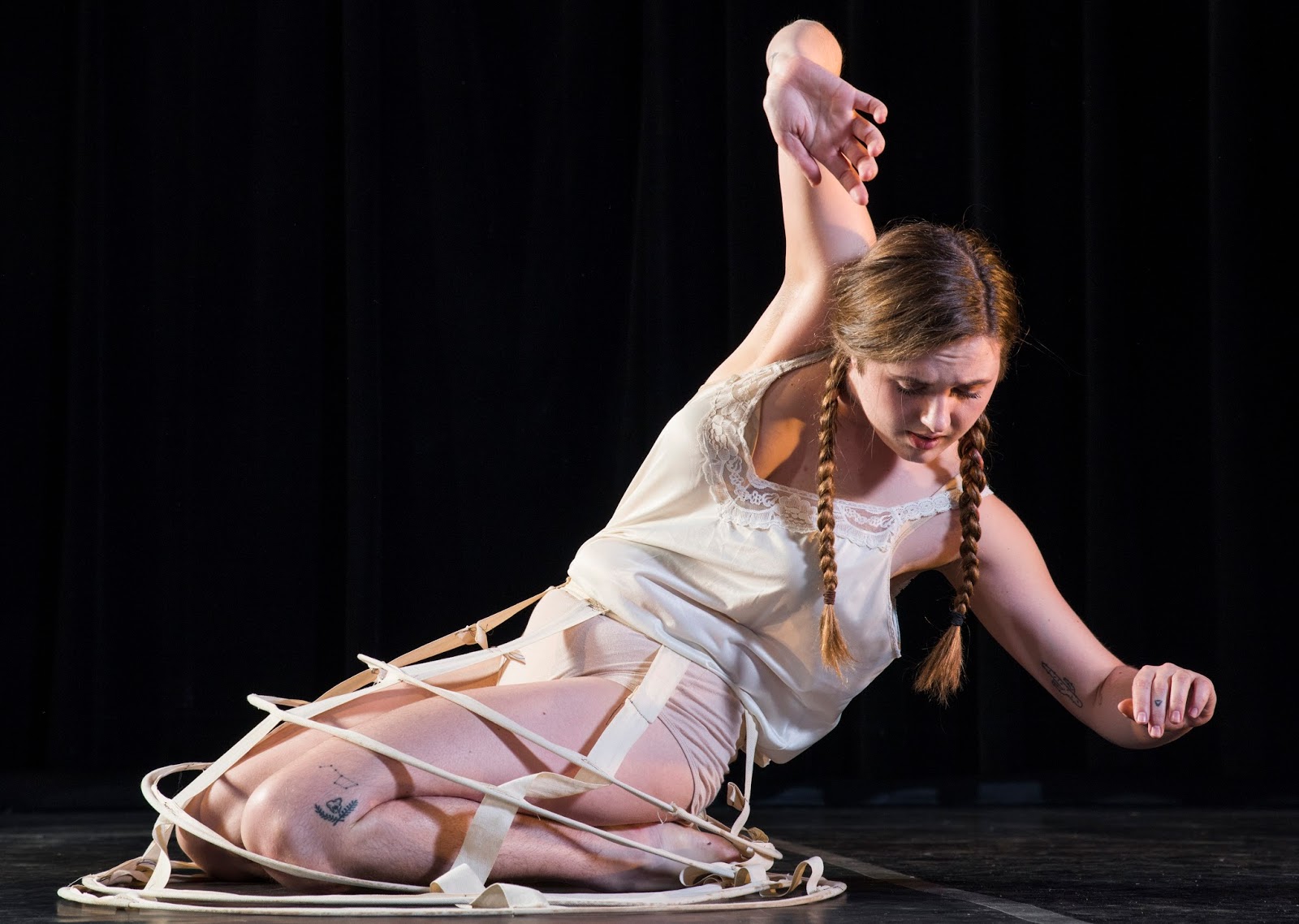
    Kelsey Brennan, Carrie Walpole

Vulnerability and fear, control and spontaneity, the challenge of gender stereotypes and anxieties over body image: In life and love as well as in dance, it’s the daily battle for balance--on the edge of your feet. 

On the Edge Of Your Feet, the HSU spring dance concert, is performed Thursdays through Saturdays, April 3-6 and 11-13 at 7:30 p.m. and April 7 at 2 p.min the Van Duzer Theatre on the HSU campus in Arcata. $10 general/$8 seniors, students and children, with a limited number of free seats to HSU students at each performance, from HSU Box Office (826-3928) or at the door. Directed by Sharon Butcher, produced by HSU Department of Theatre, Film and Dance.

Media: KHSU Artwaves, Tri-City Weekly, North Coast Journal, Humboldt State Now.  Reviewed in North Coast Journal.

Thursday, March 21, 2013

   Dancers Walter Fogler and Kara Ajetunmobi

With the usual variety in styles and movements, this year’s HSU dance studies concert features more student choreography, and is accented towards the contemporary in music as well as dance. Contemporary issues inspired many of the choreographers.
                                                                Carrie Walpole

There are three solo dances: “In the Void” by Carrie Walpole’s (which was selected for performance in this year’s American College Dance Festival), "Pieces on the Floor"  by Dani Gutierrez, and "Mirror Mirror on my Thighs" by Keili Simmons Marble.

 “We had many good solos this year,” said artistic director Sharon Butcher. “It was hard to choose just three.”

Of the remaining eight dances, seven are also by students (including “Courage in Both Hands” by Jenny Wright, selected as well for the American College Dance Festival) and one by dance faculty member Laura Munoz.
                                                                    Keili Simmons Marble, Jared Mathis

While some of the dances emerged from a class process designed to investigate elements of personal growth or social issues, nearly all the choreographers named such subjects as influencing the creation of their dances. Their challenge was to develop a dance vocabulary to give body to these explorations.

 What the inspiration for many of these dances might have in common is the struggle for balance, in life as well as in dancing “On the Edge of Your Feet.”

 In Carrie Walpole’s solo, the dancer’s goal is to find a balance between control and letting go. Kelly-May Roberts explores the pressures of negative energy that can unbalance a life by going to the dark side to explore a body taken over by evil.

 In Jenny Wright’s “Courage in Both Hands,” dancers explore the balances of fear and vulnerability involved in authentic human connection. Kara Ajetunmobi is inspired by balancing the security of the familiar with the challenge of the new.

 Other dances explore the possibilities of balancing the natural and the artificial, group and individual, confidence and uncertainty. Or they explore forces that throw you off balance, like cultural notions of body image and gender stereotypes, or opposition and the unforeseen.
                            Keili Simmons Marble

Another regular feature of the annual dance concert is a raffle that helps support such activities as sending student dancers to the American College Dance Festival and Conference.

 “I often see a big jump in the maturity of the dancers who attend the festival,” Sharon Butcher said. “When they see what other dancers in other places are doing, it really makes a difference. There’s a greater level of maturity, ability and attitude about the art form. It shows as well in their performance skills.”

 This year the prizes from local businesses include an ipad mini, as well as gift certificates. Tickets will be sold at all performances, and the drawing is held on the final Saturday.

Note: The following descriptions of dances in the concert are based on statements by the choreographers. 

On the Edge of Your Feet: The Dances


Pieces on the Floor
Choreographer and dancer: Dani Gutierrez

 A solo that uses jazz to contrast power with the loss of control, and to show how stability can become disrupted by uncertainty.

 Dani Gutierrez is a junior majoring in English and Dance Studies.
    Dancers: Hailey Oster, Julia Kandus,  Keili Marble

  Vibora
  Choreographer: Fiona Rose Melia and Dancers
Dancers: Shannon Adams, Jacqueline Bookstein, Julia Kandus, Lyndsey Lascheck, Keili Simmons Marble, Hailey Oster.

 A dance investigation of organic movement punctured by acute twitches of existence. 

 Fiona Rose Melia is a sophomore majoring in Dance Studies.

    Dancers Patricia Carter, Jared Mathis, Jasmine Wolfe

   Best Kept Secret
   Choreographer: Kelly-May Roberts 
    Dancers: Micol Arias, Bevon Brye, Justin Betancourt, Jacqueline Bookstein, Patricia Carter, Tyler Fisher, Jared Mathis, Emily Pinckney, Jasmine Wolfe.

 The dancers embody how evil can penetrate and dominate physically and emotionally, to explore the effects of negative energy that surrounds us in all walks of life.

 Kelly-May Roberts is a British exchange student majoring in Dance Teaching and Performance.
                             
    Dancers (foreground): Carrie Walpole, Keili Simmons Marble; (back) Kelsey Brennan, Jared Mathis               
                    
                    Living the Dream
                   Choreographer: Camille Ruiz
                   Dancers: Micol Arias, Kelsey Brennan, Dani Gutierrez, Jared Mathis, Keili Simmons Marble, Aimee Page, Bekah Staub, Carrie Walpole.

 A piece that applies the use of force, while honoring individual differences, desires and personal insights.

Camille Ruiz is a senior majoring in Dance Studies and Cellular/Molecular Biology.


   In the Void
 Choreographer and dancer: Carrie Walpole

 A contemporary solo highlighting the contrast between the body’s flow and tension, inspired by the struggle to push against inhibiting barriers to personal growth. The dancer’s goal is to find a balance between control and knowing when to let go, as well as how to embrace love when it is within her capabilities, and accept the loss when it is not. 

 Carrie Walpole is a senior majoring in Dance Studies.
    Dancers: Kara Ajetunmobi and Walter Fogler

Innermost Secrets
Choreographer: Lizzie Chapman
Dancers: Kara Ajetunmobi, Walter Fogler.

 A duet that combines contemporary movement with movement created naturally through feeling. 

 Lizzie Chapman is a junior majoring in Theatre Arts and Dance Studies.
     Dancers: Kelsey Brennan, Kara Ajetunmobi, Jasmine Wolfe

   Courage in Both Hands
   Choreographer: Jenny Wright
   Dancers: Kara Ajetunmobi, Kelsey Brennan, Kelly-May Roberts, Camille Ruiz, Jasmine Wolfe.

 How do we approach life with the courage of vulnerability? Jenny Wright’s contemporary choreography focuses on the struggle to allow ourselves to be seen as we truly are, despite the fear we are not enough.

 Jenny Wright is a sophomore majoring in Dance Studies.
   Mirror, Mirror on my Thighs 
   Choreographer and Dancer: Keili Simmons Marble

 This solo dance grapples with body image and the personal doubts created by infectious cultural notions of female beauty. 

 Keili Simmons Marble is a senior majoring in Theatre, Dance Studies and Biological Anthropology.
                       Dancers: Fiona Melia, Dani Gutierrez, Carrie Walpole

Seeking the Bubble
Choreographer: Kara Ajetunmobi
Dancers: Kelsey Brennan, Dani Gutierrez, Briana Hare, Fiona Melia, Claire Paterson, Allie Phinney, Camille Ruiz, Carrie Walpole, Jenny Wright.

 Using swift and fluid movement, partner work, group sections and solos, this dance is inspired by the challenge of leaving the comfort zone for the unfamiliar in order to attain a goal. 

 Kara Ajetunmobi is a senior majoring in Dance Studies.
                    Dancers Bevon Brye, Nathalie Mostrel, Eboni Sessions   
      
   Living with Thirst
   Choreographer: Laura Munoz 
    Dancers: Bevon Brye, Lyndsey Lascheck, Nathalie Mostrel, Eboni Sessions, Eric Sorensen.

 A dance that explores trust and a sense of journeying together in an ensemble. “I like to play with lines of force in the space, with action and consequence, with spontaneous action, and with the musicality of one dancer, a duet, a trio, a quartet—all of the possible combinations of dancers.” 

 Laura Munoz teaches dance in the HSU Department of Theatre, Film and Dance.
       Dancers: Dani Gutierrez, Kara Ajetunmobi, Camille Ruiz

As One
Choreographer: Carrie Walpole
Dancers: Kara Ajetumobi, Dani Gutierrez, Kendall Lewis, Kelly-May Roberts, Camille Ruiz, Jasmine Wolfe.

 The dancers push the boundaries of gender stereotyping to explore the different kinds of strength within women, both individually and together as a group. 

Carrie Walpole is a senior majoring in Dance Studies.

On the Edge of Your Feet: Our Production

Artistic Director: Sharon Butcher
Lighting and Multi-Media Presentation: Greta Stockwell
Sound Design: Glen Nagy
Original Music Composer: Ian Taylor
Technical Director: Jayson Mohatt


Volunteer Costume Designers:
Erica Fromdahl ("In the Void," "As One")
Monica Siegenthaler ("Vibora")
Katie Dawson ("Pieces on the Floor")
Ryan Ayala ("Living the Dream")
Kaden O'Keefe ("Best Kept Secret")

Costume Mentors: Catherine Brown, Rae Robison
Other Costume Contributions: Kevin Sharkey


Sunday, March 10, 2013

March 2013: HATER

Is the 21st century a classic farce? Or is it just high fashion high school? Humboldt State University Department of Theatre, Film and Dance presents the West Coast premiere of Hater, Samuel Buggeln's bold new translation of Moliere’s comedy The Misanthrope, for two weekends: Thursdays through Saturdays,  February 23 to March 2, March 7 to 9 at 7:30 p.m., with a Sunday matinee at 2 p.m. on March 10 in the Gist Hall Theatre on the HSU campus in Arcata. Tickets: $10/$8, with limited number of free seats to HSU students at each performance, from the HSU Box Office (826-3928) or at the door.  Directed by Michael Fields.

Media: Humboldt State Now, Tri-City Weekly, featured event HSU Calendar, Arcata Eye, Stage Matters

Sunday, March 3, 2013

HATER Translator on HSU Campus During West Coast Premiere

This 21st century version of Moliere's comedy The Misanthrope was translated by New York director Samuel Buggeln, who will be on the HSU campus for two public events this weekend.

 On Friday, March 8 he will participate in a "talkback" after the play in Gist Hall Theatre.

 On Saturday from 3 p.m. to 5, he will be on hand in the Studio Theatre to talk and answer questions. In addition, he will be the honored guest for a pot-luck dinner with members of the production, at 5.

Here's more on Buggeln (including how to say his name when you meet him.)  Hater concludes its HSU run and West Coast premiere Thursday-Saturday at 7:30 and Sunday at 2 p.m. in the Gist Hall Theatre.

Monday, February 25, 2013

HATER on Art Waves

Members of the HSU Theatre, Film & Dance production of HATER will be interviewed on the KHSU radio program Art Waves with Wendy Butler on Tuesday Feb. 26 at 1:30 p.m.

Tuesday, February 12, 2013

Alex (played by Charlie Heinberg) is brilliant, admired and close to the center of a nation’s power. But he has two problems. The first is that in a world of flattery-to-your-face and snark behind your back, he says exactly what he thinks. About everything-- and everybody. All the time. To everyone. Somehow this offends people.
His second problem is Celine (played by Johani Guerrero). She is young and beautiful, an acid-tongued gossip and outrageous flirt. She says what everyone wants to hear, and so is always the center of attention. She should be exactly what Alex despises. Nevertheless, Alex is hopelessly in love with her. And sometimes, she seems to be in love with him. But then...

Those who know the classic Moliere comedy The Misanthrope may be amazed at how contemporary it seems in this 21st century translation called Hater. Those who aren’t familiar with it might wonder how hundreds of years ago and an ocean away, Moliere was so tuned in to today.

This translation by New York-based director Samuel Buggeln has been controversial, but widely praised. “Hater is not your grandmother's Molière,” said Jody Enders, professor of French and theatre at University of Southern California Santa Barbara. “It is Molière for the twenty-first century... In [Buggeln’s] hands Le Misanthrope has never been more alive, more fun, more contemporary, more eternal.”

 But for all the contemporary banter (and frequent strong language), Hater follows the Moliere play exactly. Alcestus is now Alex, Celimene is now Celine, but the course of their romance is the same. So are the other characters, their alliances and enmities in the court intrigue—which, as it turns out, is a lot like high school, or the workplace.

“It’s fast and furious, physical and funny,” said director Michael Fields. “But it’s also a love story.” The lovers are star-crossed, not in their circumstances, but in their characters. “Alex is an iconoclast, but Celine is a social animal—she says she can’t stand not being in a group.” Yet Alex is overwhelmed by Celine’s beauty and charm—he knows his attraction is irrational. “Celine is attracted to Alex because he’s an iconoclast. He tells the truth and it’s so funny—because at first it sounds like gossip, but he actually means it.”

Fields uses music and staging to make connections to the contemporary world. Inspired by a Ralph Lauren extravaganza he saw in Versailles, the stage is a fashion show runway, with the audience seated around it. Outrageous clothes (not to mention the shoes!) and the actors’ poses accentuate the theme.

“These are young characters, and these are obsessions that are as much a part of being young today as they were in Moliere’s time.”

HATER: Our Cast

Alex: Charlie Heinberg
 Phil:  Brodie Storey
 Celine:- Johani Guerrero
 Ron: Mark Teeter
 Cashin: Galen Poulton
 Clinton: Luke Tooker
 Liane: Michelle Purnell
Zinna: Andreina Loaiza
Woody: Adrienne Ralsten
Basque: Derek Burns


Derek Burns and Adrienne Ralsten in rehearsal

HATER: Our Production

 Director: Michael Fields
Producer: Margaret Kelso
Assistant Director: Shea King
Costume/Scenic Design: Rae Robison
Lighting/Sound Design: Telfer Reynolds
Hair and Makeup Design: Kimberly Haines
Stage Manager: Jessica Loura Hardwick
Assistant Stage Manager: Kai Thomas
Asst. Costume Design: Marissa Menezes
Costume Shop Coordinator: Catherine Brown
Asst. Lighting Design: Juan Carlos Contreras
Asst. Sound Design: Lynnie Horrigan
Lighting Design Advisor: James McHugh
Sound Design Advisor: Glen Nagy
Technical Director: Jayson Mohatt
Props Master: Kelsey Hardwick
Stage Manager at Work: Jessica Hardwick

Technical Crew: Bethany Currier, Erica Fromdahl, Victoria Goddard.


HATER: the Director

Michael Fields is Producing Artistic Director of the Dell'Arte Company and Director of the California Summer School of the Arts.  He has directed and acted in Moliere plays and adaptations, including a starring role in the Dell'Arte production of Tartuffe.  He is currently teaching an advanced acting class at Humboldt State that is preparing a show on Alexander von Humboldt for next fall, part of the HSU centennial.  The following is an edited interview about the HSU Theatre, Film & Dance Department production of Hater.

What’s Hater about?

 “It’s about a guy—Alex in this translation-- who can’t stand not being able to tell the truth, especially socially and to authority. So eventually he has to make a choice between living in this particular world, or dropping out.

But it’s also a love story. He’s in love with Celine, but it doesn’t fit into the construct he has for himself. So it’s a contradiction in his life—he can’t get over it and he can’t abide it. A tough place to be in.

 Alex is one of those guys—and I’ve met several—who has certain absolutes. Phil, his best friend in the play, keeps trying to reason with him but he’s such an iconoclast that he can’t compromise. But of course the penalties you pay in this world for that can be high. When you have high ideals and try to live by them, the world can become a difficult place.

 Celine is an experienced woman—she’s been married once—but she’s still only 20. I don’t think she comes from great wealth, so her drive is to stay in with the royal court. She’s a social animal, she’s attracted to Alex because he’s an iconoclast. He tells the truth and it’s so funny, because at first it sounds like gossip but he actually means it. She’s keeping four or five guys in the air—I think they all want it but I don’t think any of them gets it. She’s not sleeping around, just promising things that don’t get delivered.”

 Is Moliere’s The Misanthrope autobiographical?

“Some people think so. I don’t think Alex is necessarily him, but he did marry a younger woman and she did give him room to doubt her faithfulness on all kinds of levels. You do see that situation appear in many of his plays.”

 What attracted you to this translation?

 I met Samuel Buggeln in New York. We had a cup of coffee, he’s a really great guy. He speaks fluent French, and his translation is absolutely faithful to the original in its structure. The difference is that he updates the language, and he doesn’t rhyme it, as Moliere does.

 The language—which has a lot of colloquial four letter words—makes this accessible to contemporary audiences, especially young audiences. And that’s a good audience for it because this is a play about youth, about fashion and pretense, gossip and position. We use a lot of music to show how contemporary it really is.”

 The New York Times reviewer called the original production’s style “Bling Baroque.” How are you approaching it?

 Bling Baroque! Elements of baroque contrasted with very contemporary stuff. It’s staged as a fashion show.  The stage is like a fashion show runway, and the audience will be pretty much all around it. They’ll be close to the action. I saw a Ralph Lauren fashion show in Versailles—it was really extraordinary as an inspiration.

 At the same time, we’re not making it about the set. It’s about the actors. Moliere wrote for actors and this is an actors’ piece. It should be fast and furious, physical and funny. But there are some real consequences in the final act, so the actors have to take the characters seriously. Some of the humor comes from taking them seriously—it’s the human comedy. That’s what Moliere nailed. He got to the heart of that kind of comedy. The difficulty of acting it is that the characters aren’t cutouts—the actors have to feel it.

 I think students will really like it, really enjoy the speed and the spectacle of it. It has an appeal and a connection to this audience. But anybody who expects the traditional Moliere will be horribly disappointed, and maybe terribly offended.”

HATER: The Translator

 Samuel Buggeln (who says his name is pronounced “like bug-ellen. It rhymes with melon. Or felon”) founded Vancouver’s Liquid Theatre, a company devoted to site-specific work. He is the veteran artistic associate for the Obie-winning New Ohio Theatre Company, where he directed the first production of Hater.

 Buggeln is also New York City-based Artistic Associate for Portland Stage, a regional theatre in Maine. He has cast and directed many of their recent shows. He works on new plays in New York at the Lark Development Center. He developed and directed Bedbugs!!!, an 80s sci-fi musical, which won 5 jury awards from the New York Musical Theatre Festival on its way to Off-Broadway.

 He also developed and directed Go-Go Kitty, GO! which received the Best Play FringeFirst Award among 200 shows at the FringeNYC festival.


 As translator, Buggeln notes that Hater is the first version of Moliere’s The Misanthrope to be done in free verse rather than rhymed. While Moliere’s rhymed lines sound colloquial in French, the effect is not at all the same in English, he says. “Rhymes are vastly harder to find in English than in French, for lots of technical reasons. This forces the translator into all kinds of textual inaccuracies, stilted locutions, and poorly landed jokes. And once s/he has gone to all that trouble, the effect of rhyming couplets in English is completely unlike their effect in French, so there goes any feeling of equivalency anyway.”

 But he didn’t drop the idea of rhyming (and there are a few in his text) as a matter of principle or to make a point. “I didn't land on my approach by thinking through these arguments, of course. I found my way here by experimentation, simply looking for a way to transmit in English what was most exciting to me about the play in French.”

 Though this approach is somewhat controversial, other translators and academics have supported his version. “Samuel Buggeln's living and lively translation breathes new life into those old alexandrines,” according to Jody Enders, a professor who translates medieval French farce. “In his hands Le Misanthrope has never been more alive, more fun, more contemporary, more eternal.”

 “Buggeln's bold new translation of Le Misanthrope offers a fresh approach that crackles with a contemporary sensibility while remaining true to the original source,” commented professor Jordan Schildcrout. “Without gimmicks or glibness, Hater makes Molière's sharp and witty satire available to today's audiences with the most playable and pertinent translation I've had the pleasure of hearing in the theatre.”

Website for HATER
Samuel Buggeln's website

HATER: The Playwright


Jean-Baptise Poquelin was born in 1622 to a prominent Parisian family. His father was the King’s upholsterer. As a young man he set up a theatrical troupe that performed in an abandoned tennis court. After a couple of years the troupe went bankrupt, and Jean-Baptise, unable to pay its debts, was sent to prison. When his father paid what he owed and got him out, he disappeared forever.

 In fact he became an actor touring the French provinces, under the stage name of Moliere.

 As Moliere, he acted in French provincial towns for the next 13 years. While based in Lyon, he was fascinated by companies from Italy performing Commedia dell’Arte.

 He returned to Paris in 1658, where court theatre was strictly formal and based on classical models. But he had the good fortune to arrive early in the reign of a new King who liked to laugh. With the patronage of the Duke of Orleans, Moliere brought his new company to perform before the king. The classical tragedy performed first was received politely. But the farce that Moliere staged next was the hit of the evening.

 Thanks in part to the funnybone of King Louis XIV, Moliere survived and triumphed with his comedies, though they were always controversial for their satirical attacks on Parisian pretensions. His mocked the hypocrisy of marriage in The School for Husbands and The School for Wives. He took on clerical and upper class hypocrisy in Tartuffe (which was banned for a time) and the pretensions of medicine in The Doctor Despite Himself. The amoral morass of the wealthy upper class was his target in The Miser.

 During his 14 years in Paris, Moliere often acted in his own plays. In 1673, he starred in the Imaginary Invalid about a hypochondriac, and performed his famous coughing fits. But this time they were real. After coughing up blood on stage, he finished the performance, but died later that night. He was a victim of pulmonary tuberculosis, perhaps contracted when he was imprisoned as a young man. He was 51.

 Moliere wrote and produced The Misanthrope in 1666. Widely considered his best play, this first production was a commercial failure. It is known as a departure from farces (and Commedia dell’Arte) that depend on stock characters and action. The story progresses by the revelation of character and off-stage events rather than disguises and mistaken identities, comic coincidences and confrontations, and other conventions.

 “Misanthrope”—from the Greek words meaning “one who hates mankind”—was a fairly new word in Moliere’s time (its use dates from 1650.) In Moliere’s play, Alceste is cursed by the inability to say anything other than what he actually thinks and feels. Does this make him a fool or a hero?  French philosopher Jean-Jacques Rousseau felt he was a hero, and complained that he was always played as a fool.

 Should Alceste be admired for his honesty and perceptiveness? Or should he be mocked for being unrealistic, narcissistic and impractical? That the play offers evidence for both points of view is perhaps one reason it has endured.

HATER: in context

Both as participants and audience, HSU students have the opportunity to experience this contemporary take on a classic 17th century comedy. It is part of the variety and balance that the Department of Theatre, Film & Dance seeks to achieve in its yearly schedule. Prior productions this year were a contemporary issues play (8) and an ancient East Asian classic (Shakuntala.) A contemporary American drama (Proof) rounds out the season later this spring, in addition to the annual dance concert and the annual film festival.

Thursday, November 29, 2012

December 2012: SHAKUNTALA


HSU Department  of Theatre, Film & Dance presents a new adaptation of the magical love story from India, Shakuntala, a family-friendly show in Gist Hall Theatre on the HSU campus in Arcata for two weekends: Thursdays through Saturdays November 29-December 1, and December 6 through 8 at 7:30 p.m. with Sunday matinees at 2 p.m. on Dec. 2 and Dec. 9. Tickets $10/$8, with limited number of free seats to HSU students at each performance, from the HSU Box Office (826-3928) or at the door.  Directed by Rae Robison from a new adaptation by Margaret Thomas Kelso, with music by Brian Post. 

Media: Listen to ARTWAVES on KHSU on Tuesday November 27 at 1:30 p.m. for interviews.
North Coast Journal holiday preview,  Humboldt State NowTri-City Weekly, Arcata Eye.

Tuesday, November 13, 2012


It’s the greatest love story in Indian drama, yet it has all the elements of western fairy tales: it’s Cinderella with a twist.

With epic sweep, gods and demons, magic and curses, singing and dancing and shadow puppetry, it’s an exotic addition to the holidays for the whole family.

Shakuntala: The Story

                                                               Rose Gutierrez-Jimenez

This is the tale of the beautiful, half-divine Shakuntala, orphaned in an isolated ashram surrounded by the magic of nature.


                                   Mark Teeter

While hunting, the noble king Dushyanta sees her, and falls in love with her.  And she falls in love with him.