Showing posts with label Clyde Fitch. Show all posts

Saturday, October 4, 2014

October 2014: HER OWN WAY

Greta, Glenys and Danny Stockwell
The first play ever produced by Humboldt State one hundred years ago is presented again, this time as a radio-style dramatization.

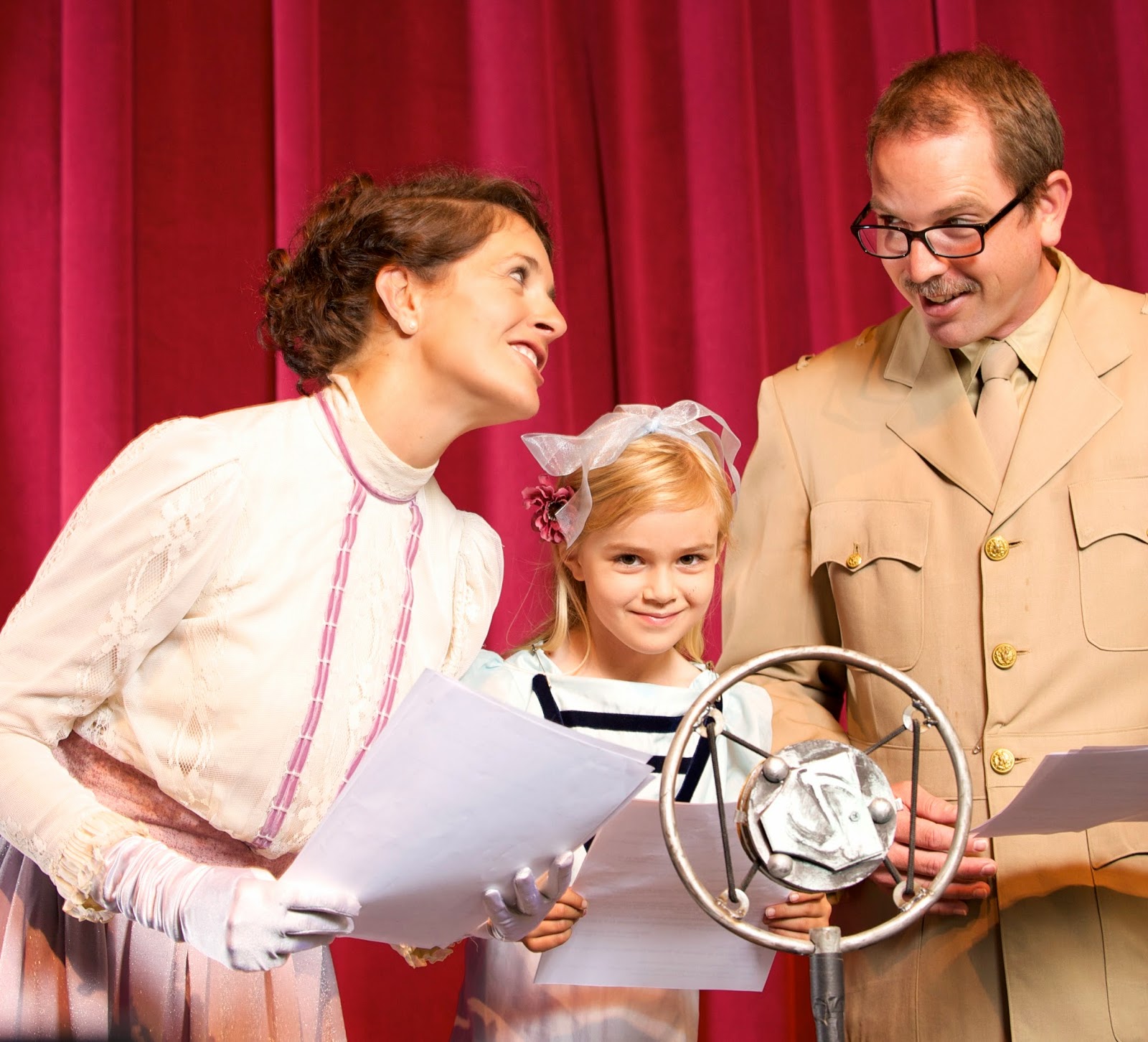
 Greta Stockwell plays the resolute heroine, while Danny Stockwell is the man she loves, and Calder Johnson is the ruthless businessman who comes between them in the Broadway hit, Her Own Way. 

 Other characters in the cast of 15 are portrayed by HSU Theatre, Film & Dance department faculty and staff, plus special guests (including young Glenys Stockwell.) 

 Scheduled for Homecoming Weekend, it is a celebration of theatre at HSU for alumni and past participants as well as today's HSU. 

 Her Own Way is performed on Friday October 3 at 7:30 p.m (with reception afterwards) and Saturday October 4 at 2 p.m. in the Van Duzer Theatre. Tickets are $5, students admitted free, from the HSU Ticket Office (826-3928) or at the door. 

Media: cover story in Urge, Eureka Times-Standard arts magazine; Mad River Union, HSU Now, North Coast Journal.

Wednesday, September 24, 2014

Susan Abbey, James McHugh
Just seven months after Humboldt State began classes in 1914, Her Own Way was produced with a student cast at the brand new Minor Theatre in Arcata. 

 Derek Lane, who is coordinating the event with fellow faculty member Susan Abbey, notes that this will not be a full production as in 1914, though there will be some costumes and scenery. “We’re doing it on stage but as a radio show, complete with period commercials and jingles.”
Her Own Way is by Clyde Fitch, one of the most successful playwrights of early Broadway. “He was known for writing strong central roles for women,” Lane said. “Georgiana, the heroine in this play, exhibits great independence and integrity.” 

 Set in a well-to-do New York City household, the play involves subjects that are still relevant, such as stock market speculation and a controversial war—as well as the troubled course of true love.
Though it was a Broadway hit in 1903, today’s audiences might appreciate a shorter version, Lane suggested. “We’re aiming for about 90 minutes, with intermission." 

"We want this to be a celebration of theatre at HSU. It’s Homecoming Weekend, so we want to include alumni and former members of our department, as well as current faculty and staff and their families.” 

 Both Friday and Saturday’s radio-style dramatizations will be live-streamed on the Internet at http://r3dux.com/live  

HER OWN WAY: Our Cast

Georgiana: Greta Stockwell
Lt. Richard Coleman: Danny Stockwell
Sam Coast: Calder Johnson
Steven Carley: JM Wilkerson
Mrs. Carley: Bernadette Cheyne
Philip: Bryan Kashon
Christopher: Dylan Wilkerson
Toots: Glenys Stockwell
Elaine: Melissa Smith
Miss Bella Shindle: Nadia Adame
Moles: Michael Thomas
Footman: James McHugh
Narrators: Susan Abbey, James McHugh
The Announcer: Mark Swetz
Commercials & Jingles: Rae Robison, Susan Abbey

HER OWN WAY: Our Production

Co-Conductors: Derek Lane, Susan Abbey
Production Stage Manager: Ellen Martin
Scenic Design & Execution: Derek Lane and TA 137 Class
Lighting Design: Brodie Storey
Costume Coordinator: Jenn White
Sound Design: Christopher Joe
Sound Board Operator: Jeanne Fashauer
Projections Design: CJ Thompson

Administrative Support: Debra Ryerson, Lorraine Dillon
Photography: Kellie Brown
Publicity/blog copy & design: Bill Kowinski

HER OWN WAY: The Original Humboldt Production

Humboldt State Normal School held its first classes in April 1914. By May, 63 women and 15 men were learning to be teachers.

 According to the history compiled by former Theatre Arts chair John F. Pauley, the first rehearsals of Her Own Way began shortly after. That fall the show was announced as a benefit for the local chapter of the Belgium Relief Fund (see "The World in 1914" post below.)

Six women students and three children from the Normal Training School were in the cast. So were five men, which constituted a third of the initial male enrollment.


The production was staged on Tuesday evening, December 8, 1914 at the Minor Theatre in Arcata, which itself had just opened for the first time on the previous Thursday night (December 3). Though the Minor was designed to show movies (and is famous as the oldest currently operating movie house in the US), it has mostly been forgotten that it also hosted many stage productions, including some 40 locally produced shows in its first decade.

 So Her Own Way was not only the first Humboldt State produced play—it was the first play to be done on the Minor Theatre stage. Today, plans are underway to bring this HSU radio-style reading to the Minor on the actual anniversary date of December 8, 2014.

 In 1914 Arcata had a population of only 1,200, and it would be a decade before a decent road connecting it to Eureka was built. But just as the Minor Theatre had no trouble filling its 524 seats for silent pictures, Her Own Way also had a “standing room only” audience.

 Humboldt State continued to produce shows at the Minor Theatre (including HMS Pinafore in 1915.) When Founders Hall and its theatre were built in 1922, Humboldt State stage shows at last had their own home—though HSU productions often toured around Humboldt County through the 1950s.

HER OWN WAY: The Playwright

Many histories of Broadway theatre begin in the 1920s. But there was never more theatrical activity along the Great White Way than in the two decades before that. At the turn of the 20th century there were between 40 and 50 theatres producing plays in Manhattan—more theatres than London or Paris or any other city in the world.

 During the theatre season, from three to ten shows might open on a single night.  After a Broadway run, some 400 touring and stock companies took the show to theatres across the US.

One of the first great figures of early Broadway was the playwright Clyde Fitch. New York theatre was dominated by European playwrights when Fitch arrived in a time of political reform, social change and artistic energy.

 In a relatively short career—about a decade—he wrote 33 original plays (or perhaps 36) plus 22 to 26 adaptations and dramatizations. Rarely was there was season between 1900 and 1909 in which fewer than two or three new Fitch plays were running on Broadway. In 1900-01 there were four. A later year, five.

 Once when two of his plays opened on the same night, he dashed from making a curtain call speech in one theatre to make another curtain call speech in a theatre across the street.

 Fitch also directed and supervised the design of many of his plays. All this activity made him wealthy—he may well have been the first American playwright to become a millionaire. He was also the first American playwright to also be successful on European stages. He spent part of the year in Europe, traveling and supervising productions.

He wrote plays everywhere—on ocean liners, in touring cars, and was said to have written one of his most famous—The Truth—in a gondola in Venice. His play Captain Jinks of the Horse Marines made Ethel Barrymore a star, and provided the Broadway debut of her younger brother, John Barrymore. Versions of the Fitch play Beau Brummel were made into motion pictures.

 Though highly commercial, his plays could push boundaries. His adaptation of Sapho caused scandal and police raids for suggesting that characters engaged in off-stage sex. His last play (The City) brought new realism (and realistic language) to the stage.

 He excelled in writing about women. They could be strong and principled or (as inThe Climbers) they might be gradually exposed as superficial and craven. He wrote plays set in drawing rooms of the wealthy, in elegant hotels and an ocean liner, but also in a crowded tenement where three young women struggle to make it in New York, in The Girls.


 “Clyde Fitch was a charming, modest man whose many letters to his many friends preserve the loyalty and generosity of a gentleman,” wrote critic and theatre historian Brooks Atkinson.

 Fitch was known as a stylish dresser, and he lived and entertained in high style. He was one of the most famous men in New York. According to Atkinson, “he was so busy that people had to make an appointment twenty-four hours in advance to talk to him on the telephone.”

 Though Fitch is mostly forgotten now, his memory is being revived in and Internet site called the Clyde Fitch Report.  According to the site's biography of Fitch, "the voluminous accounts of Fitch’s life and work rarely confront the man’s sexuality, yet he stood at the center of an energetic and colorful coterie of gay- and gay-friendly friends and colleagues."

Fitch died in 1909 at the age of 44, as the result of an emergency appendectomy (surgery with a high rate of mortality at the time.)

 After Fitch’s death a critic of the day praised him for making American themes respectable, not only in Europe but in the previously European-dominated Manhattan theatre. Fitch was credited with raising standards for design and staging, and the cultural level of theatre in general. He called Fitch the first modern American playwright.
HER OWN WAY: The Play

Her Own Way opened at the Garrick Theatre on Broadway in September 1903, and moved to the New Amsterdam Theatre and the Savoy Theatre, closing in December after 107 performances.

 It starred Maxine Elliott as the strong, virtuous and beautiful Georgiana. It was a part that Clyde Fitch probably wrote expressly for her. “Maxine Elliott, known as ‘Venus de Milo with arms,’ was the most sensationally beautiful woman on Broadway,” writes New York theatre critic and historian Brooks Atkinson. “It grieved many of her admirers that she had no talent for acting.”

 But Clyde Fitch had apparently assessed her strengths as well as weaknesses when she performed in his 1899 historical drama, Nathan Hale. In Georgiana he created a character for her that she understood, and that she could play. For the first time, Atkinson writes, “she looked like an actress. She was grateful. Even in rehearsals, she said, she knew what she was doing.”

 Elliott, who starred in another Fitch play (Her Great Match) in 1905, went on to become a Broadway star and one of the first women producers. She retired from the Broadway stage in 1920.

British-born Charles Cherry, who played her love interest (Richard Coleman) reunited with Elliott in Her Great Match in 1905. His Broadway career began in 1899 and ended in 1923 with a starring role in Somerset Maugham’s The Camel’s Back. 

The role of businessman Sam Coast, Richard’s ruthless rival for Georgiana’s affections, was played by Arthur Byron. He’d played in Fitch’s 1902 drama The Stubbornness of Geraldine (the first to take place entirely on an ocean liner) and apparently left Her Own Way shortly before it closed to star in another Fitch play, Major Andre.

 Byron had a long and distinguished Broadway career (1894-1939) playing drama, comedy, musical comedy and classics. In the 30s he played Polonius in Hamlet and the Inquisitor in Shaw’s Saint Joan.

 But the unlikely hit of the play was Georgie Lawrence, playing Miss Belle Shindle, the hairdresser. This was the first Broadway character to speak the peculiar slang of East Side New York. She was so popular that Fitch wrote a play in which everyone spoke in the East Side vernacular.


Why did Humboldt State select  Her Own Way as its first production? Perhaps the only connection playwright Fitch had with northern California was that the dining room of his elegant five-story Manhattan townhouse was made of redwood. But the key might have been the play’s strong female lead and the required cast that included six women and three children (cast from pupils at the Normal Training School.) While there were 63 female students at Humboldt that spring, the five men in the cast constituted a third of Humboldt’s initial male enrollment.

Her Own Way: The World in 1902

In Her Own Way, one of the characters goes off with the 91st Regiment of New York to fight in the Philippines. The Philippine-American War was fought from 1899 to 1902. The US acquired colonial rights over the Philippines from Spain as a result of the Spanish-American War in 1898, but indigenous revolutionaries revolted and attempted to establish self-rule. In 1898 US President McKinley (immortalized in Arcata by the statue in the Plaza) issued a Proclamation of Benevolent Assimilation and sent troops to put down rebellions.

 The rhetoric of the time—reflected in the play—was America as the benevolent agent of modern civilization to a primitive Pacific island culture. But many, including Mark Twain, vociferously opposed these wars and denounced them as American imperialism.

 A number of New York National Guard units were called into service, and twelve infantry regiments from New York fought in the Spanish-American and Philippine-American wars, though it’s not clear that the 91st—which gained fame in the Civil War—was one of them.

 One of the characters in Her Own Way is addicted to stock speculation. He can’t resist the stock tip that could bring him instant wealth. Stock speculation was in fact rampant at the turn of the 20th century, and insiders were known to provide “tips” that paid off. It was the era of the Trusts and powerful banks, with little regulation (and no income tax.) It is said that attractive chorus girls in Broadway productions made small fortunes from stock tips provided by their wealthy Wall Street admirers.

Her Own Way: The World in 1914

1914 was a fateful year in world history. The first world war—known then as the Great War—began in late July. In one of the first large-scale military operations, Germany invaded the neutral country of Belgium, on the way to invading the enemy country of France.

 The Belgian people faced immediate food shortages, when their food supplies from outside were cut and German troops requisitioned what little food they produced within the country. Early international attempts to send food failed, as the occupying Germans took it for themselves, or food shipments were stopped at the border by the British naval blockade. Belgium faced a winter of starvation.

In October a wealthy American businessman living in London, Herbert Hoover (later to be elected President) organized the Commission for Relief in Belgium. The US government was not formally involved but the CRB could operate in Belgium because the US was a neutral country (it did not enter the war until 1917). The CRB succeeded partly because it not only raised money, bought and shipped foodstuffs, but also supervised distribution within Belgium so the food got to the Belgian people.


 “The CRB conducted its humanitarian work on an unprecedented scale and with unique administrative organization,” writes historian Elena S. Danielson. “Its bold acts of benevolence were accomplished with an efficiency and integrity that later became a model for modern foreign aid.”

 Most of the funding came from various government subsidies but especially in its early months, voluntary contributions were crucial. Through his friends in the press, Hoover emphasized the plight of Belgian children.

 His wife, Lou Henry Hoover, who had attended the San Jose Normal School and Stanford University (where the Hoovers met) returned from London to California to raise funds in the state, and to organize shiploads of supplies. This is probably why there was a local Belgium Relief organization in Humboldt so soon in 1914. In time, Belgium Relief became a prestigious charity, especially for American women (including author Edith Wharton.)

For student-teachers at Humboldt State, the appeal to help children and the fund's
 California connection would have made, Belgium Relief a natural choice as the beneficiary of Humboldt State’s first play for a paying audience. That benefit performance of Her Own Way on December 8, 1914 was a great success. The 50 cent admission charge yielded $200, plus another $15 from the sale of flowers in the lobby. (The total population of Arcata was 1,200, and getting there from Eureka was still difficult.) After expenses, probably about a third went to Belgium relief.

Her Own Way: The World in 1926

Though this radio-style HSU reading of Her Own Way commemorates the first Humboldt State performance in 1914, radio drama didn’t actually begin until the 1920s.

A pioneer radio station went on the air in San Jose in 1909, but it probably was not until 1921 that the first drama expressly scripted for radio was broadcast by KDKA in Pittsburgh. In any case, within a year or two, there were radio performances of plays, dramatized events, musical comedy and opera all over the country.

 But the kind of radio drama most often portrayed in the movies and in today’s stage presentations (complete with sound effects etc.) was more a creature of the 1930s and 40s.

 Along with plays on the radio came advertising, and in particular, the radio jingle. The first singing commercial was broadcast in December 1926, for a breakfast cereal that was fading in popularity so badly that its manufacturer was considering dumping it completely.

 As a kind of desperate measure, a barbershop quartet recorded a jingle about it that was broadcast in Minnesota. The cereal’s sales there immediately went up. So General Mills decided to invest in commercials-- and to keep making the cereal called Wheaties.  It has done both ever since.

Here via YouTube is that first radio jingle: