Showing posts with label von Humboldt. Show all posts

Sunday, November 17, 2013

November 2013: Humboldt Unbound


Who in the world was Alexander von Humboldt? Explore the wonder of his life as adventurer, scientist, godfather of ecology and champion of diversity and freedom in the HSU original collaborative production Humboldt Unbound, a dynamic portrait in live theatre, music, dance and spectacle. Directed by Michael Fields, with music by Tim Gray.

Thursdays-Saturdays Nov. 7-9, 14-16 at 7:30 p.m., with a 2 p.m. matinee on Sunday Nov. 17 in the Van Duzer Theatre at HSU in Arcata. $10/$8 with a limited number of free seats for HSU students at each performance. Tickets: HSU Ticket Office (826-3928). An HSU Theatre, Film & Dance production.

Media: Mad River Union, Humboldt State Now, Tri-City Weekly, North Coast Journal, Lumberjack, Lost Coast Outpost, HSU Calendar Featured Event, NCJ A&E 

Thursday, November 7, 2013

    Steve Cunha, who played the older Alexander von Humboldt, poses with his portrait.  Photo by Bob Doran.  Here are more of his photos from opening night.

Sunday, October 27, 2013

Mountains, rivers, animals, plants, a glacier, a waterfall, a forest, an ocean current and an ocean bay, not to mention streets and cities in several countries, three counties in the U.S. and a certain California state university—all named for Alexander von Humboldt. But why? Who in the world was Alexander von Humboldt? 

 After more than a year of research and creative contributions by HSU students and faculty in several disciplines, HSU Theatre, Film & Dance addresses that question with Humboldt Unbound.

 Director Michael Fields and his Dell’Arte team bring their patented brand of theatricality to Humboldt’s voyages into the outer and inner unknowns.
    Giovanni Alva as botanist Aime Bonpland, Mark Teeter as Alexander von Humboldt

Humboldt Unbound explores the wonder and perils of his South American excursions, including his efforts on behalf of Indigenous peoples, as well as facets of his important public and personal relationships. But its method is not through the usual biography.

 It is instead a fast and fluid series of theatrical transformations. So Humboldt’s bed can become a boat floating down a wild South American river, and a line of German tutors may turn into a howling French Revolution mob. Humboldt and President Thomas Jefferson might punctuate their discussion at the White House with some song and dance.

 Bold and colorful visual images, music and dance enhance Humboldt’s own words. Together with film and projection, the constantly reassembled set designed by Giulio Cesare Perrone, music by Tim Gray, lighting by Michael Foster and costumes by HSU’s Catherine Brown, the cast enacts connections that transcend a year-by-year narrative.
                          Luke Tooker as Johann Seifert

HSU student Mark Teeter plays Humboldt as the young explorer, while HSU Geography professor Stephen Cunha portrays Humboldt (who described himself as a physical geographer) in his later years.

 Luke Tooker plays Johann Seifert, Humboldt’s last companion who serves as the audience’s guide in this play. The rest of the cast performs multiple roles—not all of them human. The characters include mosquitoes, frogs, meteors and a parrot that is the last speaker of a tribal language.
             Mark Teeter as Humboldt

Who in the world was Alexander von Humboldt?

 He took science to uncharted jungles and some of the tallest mountains in the world. He created entire scientific fields.  He insisted on accurate observation of the smallest details, and he sought the connections that would describe the cosmos.  He explored the wonder—and he returned to talk and write about it, so we could share in that exploration.

 Along the way he asserted the wisdom and dignity of Indigenous cultures, and championed freedom for all. "The principle of individual and political freedom is implanted in the ineradicable conviction of the equal rights of one sole human race," he wrote. "All are alike designed for freedom."

 He was a hero of both intellectual and popular culture in the 19th century. He was the most famous scientist in the world, and next to Napoleon, the most famous individual.

 Though this “second discoverer of America” and “father of modern America” is almost unknown in the U.S. today, Cornell historian Aaron Sachs writes that his “radical approach to nature and humanity makes him an astonishingly relevant figure for the twenty-first century.”

Humboldt Unbound: Director Michael Fields

“This isn’t an historical pageant,” director Michael Fields emphasized. “It begins with the older Humboldt giving a lecture, but by that time in his life he’d had a stroke, and it fragmented his memories. We use that as a device to create a dynamic visual world that continually transforms before your eyes.”

 “Probably a good 20% of the play is Humboldt’s words, or some version of his words. You see two von Humboldt’s, one old and one young, sometimes together.”

 “Seifert was in a way his last companion, and he’s the audience’s guide through the world of this piece. We get different aspects of his relationship with his brother and mother, with Bonpland, a botanist and companion for his 5 years traveling in South America, and other people in his life.”

 “So we present different aspect of his life but not in a chronological narrative telling. One memory refracts from another, so at one point he’s climbing the highest known mountain in the world at that time, and at another he’s being shocked by electric eels in an experiment, and at some other he’s watching an extraordinary meteor shower.”

 “One of the original conceptions of the piece was to keep shifting the lens and looking for connections. Humboldt tended to look for the connections, not what separates things,” Fields said. “He saw the world as a dynamic and organic whole, where everything affects everything else. That’s influenced how we tell his story theatrically.”

 “Humboldt said he was driven by an uncertain longing to explore the external world, but actually he was seeking an internal awakening that connected all those things together.”

 Still, the explorations themselves were most crucial, which is why much of the play concerns them. “Humboldt believed that it’s dangerous to try to describe the world without traveling the world,” Fields said. “ He felt you can’t do it in a laboratory alone.”

 Humboldt was known for his commitment to precision in scientific observation and measurement, but also for insisting on the necessary role of imagination. As Fields points out, he was influenced by the Romantic movement which began in Germany and spread to England. “He really believed in intuition and emotion and not just scientific rationalism,” Fields said. “We want to reflect that on stage.”

 “Also Humboldt’s feeling for people, reflected in the passionate letters he wrote but also his friendships. Friendship was very important in that era.” Humboldt was also outspoken on behalf of Indigenous peoples, and opposed slavery and racism, even in his visit to a slave-owing President in Washington, D.C. These aspects of his life and his legacy are also reflected in Humboldt Unbound.

 “There are moments of melodrama, comedy, of musical theatre, expressive dance, and moments of direct narrative to the audience. Like Humboldt, the play is very unconventional—it’s not one thing, it’s many things. We hope it all works as a whole.”

Devising Humboldt

Giovanni  Alva as Bonpland
 Humboldt Unbound was created collaboratively, as what’s known as a “devised” work.

 “In conventional theatre, a playwright goes into a room and writes a play, comes back out and hands it to a producer,” Fields explained. “’Devised’ usually implies working with a group of people to come up with something that has not been done before. In this case it was several groups.”

 “We started with a one-unit class here at the university to gather research and ideas. Out of that came a very rough beginning of a scenario—of different ways to look at Humboldt’s life, which was kind of the mandate of the piece.” 

“That kind of research continued informally, as some of us met a few times to go further into it. Then a full semester acting class looked at it from the perspective of acting style, of generating material. That group came up with some text. I worked on text over the summer, and once we got a cast, it adjusted to what the actors did in rehearsal.”

 “At that point other collaborators came into it. For the set, music and lighting, the university allowed me to work with people I’ve collaborated with before, mostly at Dell’Arte. Plus Catherine Brown who I’ve known for many years, doing costumes. All of these influence the piece. Giulio’s [Cesare Perrone] set is a massive world, and it constantly changes. Tim Gray has written songs as well as musical underscoring, and there are dance sequences, so those get incorporated into the scenario."

"I’ve had the pleasure of working with some of the students in the cast before. For all of them the focus is how they work together as an ensemble, because outside of the two Humboldts and Seifert, everybody shifts roles, sometimes in an instant.”

 “ Humboldt became kind of a rock star in his time, but at least in the United States he’s been mostly forgotten. We’re covering a lot of ground but we’re intending to keep the piece at about 90 minutes.”

Humboldt Unbound: Our Cast

members of the cast at HSU Homecoming Parade
Old Alexander von Humboldt – Steve Cunha
 Seifert – Luke Tooker
 Young Alexander von Humboldt – Mark Teeter
Marie Elisabeth von Humboldt (Mother to Alexander and Wilhelm) – Ina Loaiza
Wilhelm von Humboldt – Charlie Heinberg
Bonpland – Giovanni Alva

Ensemble (various roles): Giovanni Alva, Johani Guerrero, Kate Haley, Samantha Herbert, Ina Loaiza, Gaelen Poultan, Chris Joe, Rilo Wage.


Humboldt Unbound: Our Production

Developed by Michael Fields with the ensemble and students and staff of HSU

Director: Michael Fields
Set Design: Giulio Cesare Perrone
Costume Design: Catherine Brown
 Sound Design/Composition:  Tim Gray
 Light Design: Michael Foster
 Stage Manager: Caitlin Volz
 Assistant Stage Manager: Lauren Hennes
 Associate Sound Design: Chelsea Tran
 Dramaturg/Assistant Director: Mary May
Associate Costume Designer and Makeup Designer: Shenae Bishop
Design Associate: Lynnie Horrigan
Properties Design: Emma Lubin
Head Dresser: Marissa Menezes
Master Electrician: Greta Stockwell
Producer: Margaret Kelso
Administrative Support: Lorraine Dillon, Debra Ryerson
Photography: Kellie Brown for HSU Marketing & Communications
Publicity/blog copy and design: Bill Kowinski

Duties of a Stage Manager can be, um, unusual: Mark Teeter with
Stage Manager Caitlin Volz...and frogs.

Humboldt Unbound: How It Started, Where It's Going

The Humboldt project began with Francisco de la Cabada of the HSU World Languages and Culture department, who envisioned a play about Humboldt that began with him addressing an HSU audience during the school’s centennial—which is exactly how Humboldt Unbound begins.

 He first thought of it as a project for his class in Spanish drama. He described his ideas to Margaret Kelso, chair of Theatre, Film & Dance. "He knows a lot about Humboldt and as he talked, my imagination just went wild,” she said. “I saw how this could be exploded into something amazing.”

 “So I talked to Francisco about this as a bigger project. Lilianet Brintrup, a colleague in his department, is an expert on Humboldt, so she became involved as well.”

 “When Francisco was first talking, I saw all these images—the meteor shower, the frogs, the parrot who was the last speaker of a Native language—and they all had the quality of spectacle. So I thought of Michael Fields and the kind of productions that Dell’Arte does.”

 “I talked with Michael and he was interested. He proposed starting with a class in devised theatre that would begin the process of creating this. As we all continued our discussions, we saw we couldn’t accomplish all of this in a single semester. So we came up with a plan for a couple of courses followed by the production. We proposed all of this to Dean Kenneth Ayoob who was very gracious in supporting it.”

 Others such as geographer Stephen Cunha became involved, as well as students in the two classes and others informally. Then the cast and creative team took over, as described by Michael Fields in the director’s interview. 

It all culminates in the two weekends of the premiere production at HSU, but may not end there. The Humboldt Unbound production has been invited to the upcoming International and Interdisciplinary Alexander von Humboldt Conference which will be held in Santiago, Chile in January 2014. This will be the seventh such conference, previously held in Latin America, China, Germany, Morocco, with the inaugural conference in Arcata in 2001. HSU’s Lilianet Brintrup is president of this conference.

 “The conference will provide room and board, and a beautiful theatre for the production,” said Margaret Kelso. “ Through the Instructionally Related Activities Fund we have a financial commitment to help send the students in the production and in technical support. We’re now seeking funding to send the necessary non-student technical people and to ship the set.”

 “This could be very cool,” said director Michael Fields. “And it’s one reason our piece is partly in Spanish.”

Who in the World Was Alexander von Humboldt?

Humboldt Unbound is part of Humboldt State University’s 100th anniversary celebration. But it’s an unfortunate fact that in the centennial year of the university named after Alexander von Humboldt, few people know much about him. That’s true across the U.S.

 Yet on the 100th anniversary of Alexander von Humboldt’s birth, he was famous. His centennial was celebrated with events, speeches, parades and the unveiling of statues across the U.S. from Boston to San Francisco. The front page of the New York Times was entirely devoted to stories about him, and about the ceremony to unveil a memorial bust in Central Park.

 Ralph Waldo Emerson described Humboldt as “one of those wonders of the world...who appear from time to time, as if to show us the possibilities of the human mind.”

 So who in the world was Alexander von Humboldt?

 He was born in 1769 in the kingdom of Prussia, the central and most powerful state of the empire of Germany. His father, chamberlain in the king’s court, died when Alexander was nine. The money in his family came principally from his mother.

Young Alexander was sickly and not a particularly good student, especially in comparison to his brother Wilhelm (who would become an eminent German academic and linguist, and Alexander’s staunchest supporter.) His only discernible talent was for drawing.

 He blossomed in college because he could study many subjects, though geology was an early passion. His health became robust and would remain so for most of his arduous life. His mother wanted him to pursue a career in finance, but during the year he spent at the Academy of Commerce he taught himself mineralogy, and was soon hired as an assessor of mines. He was so successful he was offered the directorship of the government’s Department of Mines, but he confessed that he had been more interested in the geology the mines revealed, and he really wanted to travel.

 However, he had been popular with the miners and designed a respirator so they could breathe easier and a better lamp so they could see without igniting gases in the mines. He also set up a free school for miners which he paid for, and then wrote an official report on its success. It began what became an international movement for better education for the working class.

 Humboldt continued his varied studies, and took particular interest in the philosophy of Immanuel Kant. He met many of the leading intellects of Europe. He traveled as much as he could in the mountains of Europe, including notable voyages with naturalist and explorer Georg Foster, who taught him much of what he would need on his own expeditions.

 When his mother died in 1796, Humboldt was suddenly wealthy and independent. He prepared himself for epic travel through studying several sciences and gathering the best scientific instruments he could find from across Europe.

 But it was a difficult time for travel, with many European nations at war on the seas as well as land. Several planned expeditions were aborted, including one to Africa. But a desperate trip to Spain led to a meeting with the Spanish king, who provided Humboldt and botanist Bonpland with royal passports to the otherwise forbidden colonies of South America. The king may have been charmed by Humboldt’s enthusiasm for advancing science, but he might also have been impressed by Humboldt’s knowledge of mining and minerals, as well as his willingness to finance the voyage himself.

Humboldt’s Travels
illustration by James Gurney

 When von Humboldt set out for South America, Europeans had not explored vast areas of this continent. Maps were sketchy and inaccurate, if they existed. Even charts of the waters off the coasts were faulty. When his ship approached, the captain consulted charts of three seafaring nations—all of them were wrong.

 Whatever ideas Europeans had about these areas or the people living in them were most likely sensational images and stereotypes propagated by those with a political or commercial agenda, even by men who had never actually been there. The isolation was political as well as physical—the Spanish government had forbidden explorers from entering the countries it controlled. So Humboldt’s royal passport was not only astonishingly valuable, it was rare.

The physical challenges were formidable enough. Humboldt and his party navigated wild and unmapped rivers without the benefit of engines, climbed some of the highest mountains in the world (including the fabled Chimborazo) without oxygen or modern climbing apparatus, coped with the heat, the rains, the mosquitoes and other insects, with little in the way of resources except what their own ingenuity could provide.

He carried the most sophisticated instruments he could find in Europe to measure and record everything from geographical position to the time and temperature. He gathered plants and rocks, and peered into volcanoes. His professed goal was to “study the great harmonies of nature.”

 He carefully noted the individuality of lifeforms and features, but in studying physical phenomena (as he later wrote in the introduction to Cosmos) “we find its noblest and most important result to be a knowledge of the chain of connection by which all natural forces are linked together, and made mutually dependent on each other.”

 Humboldt believed that humans can't really know nature, but only what they experience through their own perceptions.  He also understood that people relate to nature through impressions and emotions.  So in his books he presented data objectively but also described images "impressed by the senses upon the inner man, that is, upon his ideas and feelings.”
Humboldt and Bonpland.  Illustration by Otto Roth Von Holztich

 Perhaps the most fascinating and most celebrated journey was navigating the Orinoco River, the most arduous, consistently dangerous and (beset by mosquitoes and other insects) physically debilitating undertaking. But he proved that the Orinoco and Amazon basins were connected, which European maps of the time denied.

 He encountered Native tribes that did not match European stereotypes. They were diverse, with a variety of cultures and societies, with a multiplicity of languages, all very much related to place. Some had practiced agriculture for generations, contrary to European belief. Humboldt grew to respect the strength and wisdom he saw among free tribes, which made witnessing the subjugation and slavery imposed on other tribes by the Spanish all the more repugnant. They “progressively lost that vigour of character, and that natural vivacity, which in every state of society are the noble fruits of independence.”

 In Mexico he studied the remnants of the Inca and the Aztecs, their calendars and gardens, fortresses and pyramids. He was the first to reveal them as evidence of highly developed cultures.

 Before returning to Europe, he made a short but triumphant visit to Philadelphia and Washington. He spent considerable time at the White House with President Jefferson. The information he brought from Mexico and South America proved invaluable, and his descriptions of the science he practiced on his voyage informed future expeditions from Washington.

 Though this was his only visit, Humboldt felt at home in the U.S. He loved the openness and enthusiasm, and he valued it as a beacon of freedom, except for the scourge of slavery that he detested and denounced.

 The Long View


Humboldt then spent more than 20 years in Paris, meeting with scientists and other intellectuals, and writing his books, most of them based on his five years of expedition. Some of the books were technical and meant for short press runs. Some of these virtually created new sciences, including human geography. But others became internationally popular, especially Views of Nature and several volumes of his Personal Narrative of his South American journeys.

 His years of financing his own expeditions were not as ruinous as his years financing his own publication. Some of his books became so expensive to produce (with over a thousand maps and illustrations) that few of them sold. Humboldt’s fortune was spent, and he was in debt. “And in the end,” writes historian Laura Dassow Walls, “Humboldt could not afford a complete set of his own works.”

 He was forced to return to Berlin, and to become a kind of intellectual court jester to the royal court. But he also gave a series of highly popular lectures that became the basis for his crowning work, the three volumes of Cosmos.

 But it wasn’t until after a final voyage—to Siberia—and the books it generated that he actually began to assemble Cosmos. He was 75.

 Two volumes of a projected four-volume work were published in his lifetime, and a third after his death in 1859 at the age of 89. No one knows if a fourth volume ever actually existed. But he lived long enough to see the first volume become enormously popular and celebrated, making him even more famous than before.

 There are probably at least two reasons that Humboldt’s contributions aren’t well remembered. First, because he made them in so many areas that are now different disciplines, including what is now human geography, plant geography and climatology, as well as botany, ethnology, zoology and geology. He studied electricity and the earth’s magnetism. “In science, Humboldt pushed the borders of several fields by attempting to combine them, on a global scale,"  writes Aaron Sachs.

 His contributions were so many and various, there is not just one to attach to his name. He studied and named the Humboldt Current off the coast of Peru. He recognized and named the Jurassic period in geological time. He collected more than 60,000 new and rare plants. He contributed to the science of volcanoes and earthquakes, and therefore advanced understanding of those mighty forces in shaping the world. Even his early work making miners safer and creating educational opportunities would alone earn an historical reputation.

 A second reason for Humboldt’s obscurity may be that insights he argued for were far ahead of their time, but are widely accepted in ours. The distance in time is too great, with many intervening figures, for Humboldt’s contribution to be easily remembered.

 But it is simply true that Humboldt discussed the impact on climate of deforestation and other alterations in the environment. He recognized the intelligence of animals, and the interrelationship (and basic humanity) of all humans. He described how everything in nature is connected, and reminded readers “man is part of nature,” which is an easily forgotten insight of increasing importance.

 He saw that human societies can be understood only within their particular natural habitat, linking people and place. He noted as others would centuries later that the way to save the South American forests is to save their Indigenous inhabitants.

 Humboldt not only created his own network of scientists but created the prototypes for international science organizations of today. His successful efforts to encourage several nations (including Russia and England) to set up science stations around the world to monitor geomagnetic and meteorological data set the precedent for global scientific monitoring ever since, from manned and automated outposts to satellites.

 And of course, he proposed an ecological vision of interrelationships that is now well accepted in the sciences and well beyond. But Humboldt went even further in his cosmic vision, uniting the entire physical world—from distant galaxies to the smallest lifeforms-- with human perceptions and feelings, which is still beyond Western science, though some of it is moving in that direction.

Humboldt Unbound: Humboldt's Gifts

The influence of Alexander von Humboldt on sciences, the arts, the life of nations and of ordinary people from his time to ours is extensive, if by now largely forgotten. But lines can be traced from Humboldt to such diverse developments as Darwinian evolution, environmentalism, the Gaia hypothesis, landscape painting and ecotourism.

 During his lifetime, Humboldt’s influence went beyond his books and lectures. Humboldt was a master of what today would likely be called “networking.” He met and spoke enthusiastically with hundreds of scientists in various fields as well as artists, politicians and political activists on three continents. He wrote and received thousands of letters each year. Such broad and insistent networking was not common at the time.

 When in his final decades he began to assemble his crowning work—the multiple volumes of Cosmos—he had not only his own notes and writings but the latest scientific findings streaming into his mailbox from hundreds of correspondents. Cosmos has even been described as the work of an international collaborative team. Humboldt was a one-man Internet.

 After he returned to Europe from his Latin American voyages, he personally helped advance the careers of many younger scientists. His encouragement as well as financial aid was crucial to Louis Agassiz, who went on to make significant contributions in geology. Humboldt worked with an even more important geologist, Charles Lyell, who “likely derived from him the concept of dating rocks from fossils,” historian Walls believes. All three made crucial contributions in understanding that the Earth is much older than was believed.
Psychologist C.G. Jung at Lake Zurich

 His willingness to help sometimes had serendipitous effects. In Paris he met and was impressed by a young doctor from Germany, C.G. Jung, and recommended him for a professorship in Basel, Switzerland, where Jung established his family. That doctor’s grandson, also named C.G. Jung, became the famous psychologist who was able to develop his theories in the Swiss landscape through two world wars that made Germany a dangerous chaos.


 Humboldt on Walden Pond

 Humboldt’s influence on his contemporaries ranged beyond science. He encouraged the young Simon Bolivar—they climbed Mount Vesuvius together—before Bolivar led revolutions in South America. In Washington he befriended Albert Gallatin, Secretary of the Treasury in Jefferson’s administration. Humboldt’s descriptions of the diverse and impressive cultures of Indigenous peoples he encountered in South America as well as his archaeological researches into pre-Columbian cultures in Mexico inspired Gallatin to conduct the first ethnographic study of Indian tribes in the United States.

 Humboldt’s work reflected his involvement in German Romanticism, which included his friendship with Goethe, so naturally the English Romantics were interested in him. Though Lord Byron refers to him directly in a poem (a bit satirically), Samuel Taylor Coleridge met Humboldt, and literary scholars suggest Humboldt’s influence on Coleridge's Rime of the Ancient Mariner.

Scholars have also found strong traces of Humboldt’s influence in American writers of his time such as Walt Whitman, Edgar Allen Poe and Herman Melville, but most directly in Ralph Waldo Emerson and Henry David Thoreau. Both were known to have read his works.
Thoreau

 Thoreau studied Humboldt’s Aspects of Nature, Personal Narrative and especially Cosmos. Thoreau cites Humboldt several times, notably in one of his most famous essays, “Walking” (it contains his bold pronouncement, “in Wildness is the preservation of the World.”) He used Humboldt’s rigorous and relentless measuring and observation as a model for his own. “In his journals one can see Thoreau following the precepts of Humboldtian science: explore, collect, measure, connect,” Walls writes.

In his writings Thoreau, like Humboldt, often made unprecedented connections, and linked the particular to the cosmic, the natural world to the human-made world. Thoreau also saw in Humboldt an example of finding in the natural world the justification for social change. Humboldt, the pioneer scientist who spoke loudly against slavery and in support of Indigenous peoples, may have helped inspire Emerson in his activities in these causes, but perhaps more directly provided Thoreau with a model for the author of both Walden and “Civil Disobedience.”

The Descent of Darwin

Charles Darwin
 Readers—especially young readers—of Humboldt’s books did not simply become interested, or even fascinated. They were excited. This was true during his lifetime and also for decades after his death.

 Though Humboldt was still alive, Charles Darwin was born fifty years after Humboldt’s birth. As a young man he read Humboldt’s Personal Narrative, one of the most popular travel books of all time. This book, according to Darwin biographer Keith Thomson: “opened Darwin’s eyes to the world of natural history outside of the British Isles and directed his intellect to the vastness of biological diversity worldwide...”

 Darwin tried to follow in Humboldt’s footsteps with a scientific voyage to Tenerife in the Canary Islands, where Humboldt had begun his American travels. Darwin began to organize an expedition but it fell through. But soon enough he set out on his own fateful voyage on the Beagle. Darwin brought a copy of the Personal Narrative with him, and when he finally did reach Teneriffe, he re-read Humboldt’s account of his visit. But he wasn’t interested only in the scientific aspects. “Darwin was also drawn to the emotional and aesthetic tenor of Humboldt’s observations,” writes scholar Ann C. Colley. “He identified with Humboldt’s sense of awe and confusion upon entering a new land... Darwin proudly admitted that many of his thoughts and points of view were molded by Humboldt’s observations.”

 Yet Humboldt’s scientific observations—his attention to similarities under similar conditions even if thousands of miles apart—had a decided impact on Darwin’s thoughts on evolution. So did other books Darwin read on the voyage—two volumes of Principles of Geology by Charles Lyell, that through the study of rock strata established the vast age of the Earth, and that it had changed over that time. This proof of Humboldt’s ideas probably made using Humboldt’s techniques, and gave Darwin the essential ingredient for his theory of evolution by natural selection: time.

 Ironically it was Darwin’s theory, first published in 1859 (the year of Humboldt’s death) that quickly came to dominate, and perhaps hastened the obscurity of forbearers like Humboldt.

From Cosmos to Gaia 
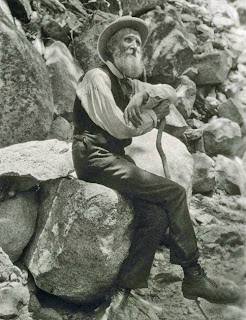
John Muir
 Even after his death Humboldt’s work continued to influence a surprising variety of important figures. John Muir worked in a factory in Indianapolis when he read Humboldt, quit his job and set forth on his own explorations “How intensely I desire to be a Humboldt!” he wrote in an 1865 letter. Muir’s journal of a thousand-mile walk across the southern U.S. got him started. Travels through Alaska, Siberia, the Arctic and most famously, the Sierras in California would follow.

 Humboldt’s last major expedition had been to Siberia in 1829. Russian playwright Anton Chekhov (born in 1860), whose youthful reading included Cosmos, made a similar voyage to the island of Sakhalin, off the coast of Siberia. This uncharacteristic trip included scientific research, with Chekhov commenting that he had to be a geologist, meteorologist and ethnographer combined, as Humboldt had been.

 Humboldt had written two books about his Russian journey, in which he again observed that deforestation changes climate. This is a notable contention also made by Dr. Astrov in Chekhov’s great play, Uncle Vanya. Astrov’s dream is to reforest the land.

 In the 1880s German anthropologist Franz Boas was resisting the strictures of his science, until he read Humboldt’s Cosmos. A chance meeting at a New York academic conference with Horatio Hale, an American ethnologist imbued with the Humboldt spirit, started Boas on the road to revolutionizing ethnology, particularly as applied to Native Americans. The Humboldt spirit passed through him to his students who included Alfred Kroeber, Ruth Benedict, Zora Neale Hurston and Margaret Mead. 

H.G. Wells
 Towards the end of the 19th century, another youthful and enthusiastic reader of Cosmos was H.G. Wells in England. He absorbed Humboldt’s scope, and his passion for making connections. Both became central to his work as a writer and public figure in the 20th century. “The end of all intelligent analysis,” Wells wrote, “is to clear the way for synthesis.”

 With Humboldt, Wells believed in a common if complex basis of knowledge as the foundation for human understanding across the world. For Wells, who foresaw in some detail the dangers of modern warfare, this understanding was crucial to the survival of human civilization. So he embarked on the Cosmos-like project of his Outline of History, which became an international best-seller.

 Wells’ Outline (and a similar attempt to summarize the sciences) might also be seen as intermediate steps between Cosmos and the Gaia hypothesis. (“Gaia”--Greek goddess of the Earth-- had in fact been one of the titles Humboldt considered for Cosmos.) Cosmos shows the relationships of many forms of life, and their relationship to other physical qualities of the planet, such as geologic features and forces, and climate.
Lynn Margulis

 Lynn Margulis, co-creator of the Gaia hypothesis (with James Lovelock), credits Humboldt as an important pioneer in establishing “the everywhereness of life.” With her groundbreaking research into bacteria and other topics, Margulis saw much more of the environment as living.

 The Gaia hypothesis goes further in seeing the planet as a living system. There is science beyond Humboldt’s involved in the technical claims of what is now the Gaia theory, but like Cosmos, the idea of Gaia continues to be inspirational and exciting for present generations in the 21st century.

Humboldt Beyond the Experts

Chimborazo 1864 by Frederic Church
 Humboldt advocated for various methods of increasing the contact of ordinary people in the urbanizing world with nature itself.

 One method was through the visual arts. "Descriptions of nature, I would again observe, may be defined with sufficient sharpness and scientific accuracy, without on that account being deprived of the vivifying breath of imagination," Humboldt wrote in Cosmos (Vol. 2.).  His paeans to landscape painting as well as the specific places he described inspired generations of American artists, beginning with Frederic Church who traveled to some of the same places Humboldt had visited in Latin America in order to paint them.

 But Humboldt didn’t write only for experts or specialists. His books were enormously popular, partly because he asserted that everyone could and should become involved in learning about the natural world. As it turned out, much of the 19th century saw a boom in such interest and involvement.

 Even before that, a lot of natural science was done by educated amateurs. (There wasn’t even such a word as “scientist” until the 1830s, and even then it meant a technical specialist for industry.) There were “natural philosophers” with university degrees, but there were also just plain “naturalists,” often clerymen with time on their hands, who collected and classified insects and birds, or rocks or fossils.

 But in the 19th century, the public was actively interested in the controversies caused by the latest fossil finds and studies of rock strata. "Almost everyone in the first half of the nineteenth century deliberated the stinging questions that geology raised about the scriptures,” observed human ecologist Paul Shepard. “The naturalist was an amateur and everyone was something of a naturalist."

An even a greater interest arose after Darwin’s theory became a newspaper sensation. In addition to weekend outings to collect rocks, it became fashionable to visit (for example) the Regent Park zoological gardens to take a closer look at a reputed ancestor, the chimpanzee. (The exhibits were so popular by the 1860s that the slang word "zoo" was coined, immortalized in a song by a popular music hall singer, the Great Vance: "The OK thing to do on Sunday afternoon is to toddle in the zoo." The first chimpanzee had arrived in 1835.)

 But before Darwin, popular interest was inspired by Humboldt, particularly for a certain kind of travel. He encouraged people to “get the true image of the varied forms of nature” by extensive travel. In the 1960s Paul Shepard called Humboldt “the father of modern tourism,” but today we would more precisely called it “ecotourism.”
Central Park NYC

 The combination of the Humboldt-inspired artists fanning out across the country and the world, and public interest in these places led to new and expanded natural history exhibits and museums in many American cities. If people cannot go to expanses of nature, Humboldt also said, then it’s better to bring nature to them. He advocated for gardens and parks, a call quoted and taken up by pioneer landscape architect Andrew J. Dowling, both in England and America. One of his prize students was Frederick Law Olmstead, who designed Central Park in New York as well as parks in many U.S. cities, and college campuses including Stanford and U.C. Berkeley. So Humboldt’s gifts are to us all.